


مليون شجرة بُن مثمرة في السعودية.. تنتج 870 طناً
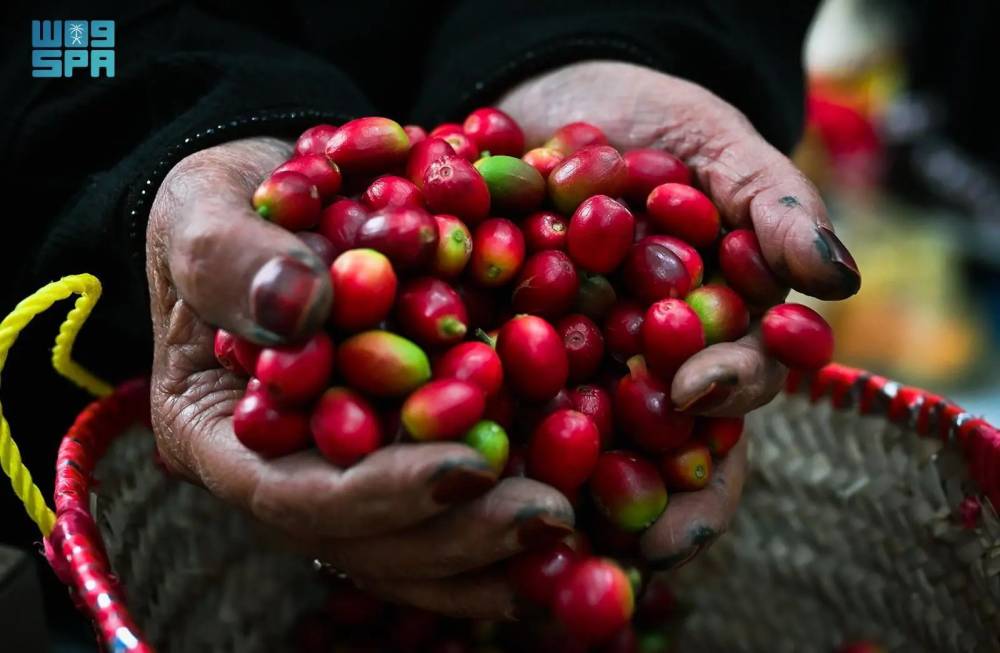


The Saudi coffee represents one of the most important national agricultural products with cultural, social, and economic value. The Kingdom pays special attention to coffee as a symbol of heritage and a promising pillar for the development of rural areas and providing sustainable economic opportunities for farmers.
Coffee cultivation in the Kingdom is spread across the highlands of the southwestern and southern regions, thanks to the nature of its climate and the fertility of its soil, which gives it high quality and a distinctive taste. The method of preparing coffee varies across different regions of the Kingdom, with each area having its own way of making coffee. In the northern regions, it is characterized by dark roasting, with the addition of cardamom, which gives it a special flavor. In the southern region, it is prepared relying on light roasted coffee, with ginger, saffron, cinnamon, and cloves added. In the eastern, western, and central regions, it is prepared with medium roasting, with cardamom and saffron added.
The Ministry of Environment, Water, and Agriculture has clarified that the regions of Jazan, Asir, Al-Baha, Makkah, and Najran host more than 1.3 million productive coffee trees, producing over 870 tons of pure coffee annually. In the Jazan region, the number of productive coffee trees exceeds 966,000, yielding more than 642 tons of pure coffee. This is followed by the Asir region with more than 243,000 productive trees, producing over 175 tons of pure coffee. Meanwhile, the number of productive coffee trees in the Al-Baha region is about 72,000, while approximately 540,000 coffee trees have been planted in the developmental coffee city in the region, which are still in their early growth stages and have not yet entered the fruiting stage. It is expected that they will contribute to increasing the region's production in the future, as the current production exceeds 36 tons of pure coffee. In the Makkah region, the number of productive trees exceeds 12,000, producing more than 10 tons of pure coffee, while the Najran region includes more than 9,000 productive trees, yielding over 7 tons of pure coffee.




