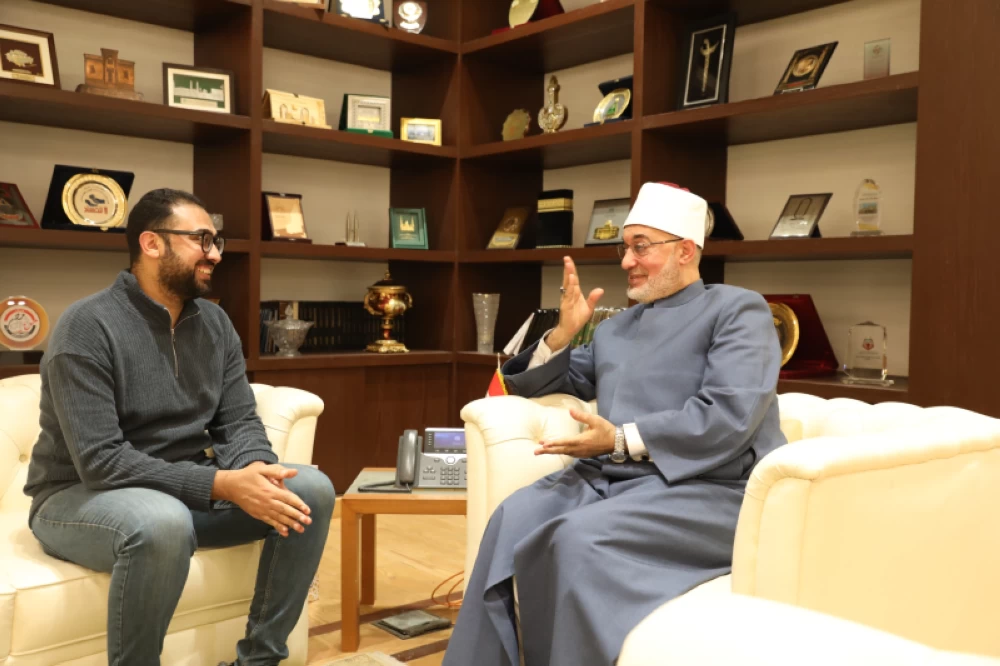
في ظل التحولات الفكرية والتكنولوجية المتسارعة، يبرز دور المؤسسات الدينية الرسمية بوصفها صمام أمان لحماية الوعي وصيانة الاستقرار المجتمعي، ويكشف مفتي جمهورية مصر الدكتور نظير عياد، في حوار خاص لـ«عكاظ»، عن رؤية دار الإفتاء المصرية لدور الإفتاء المعاصر باعتباره «صناعة حضارية» تتجاوز حدود البيان التقليدي للحكم الشرعي، لتسهم في ترسيخ الأمن الفكري، ومواجهة التطرف، وبناء خطاب ديني وسطي منضبط يستوعب متغيرات العصر دون تفريط في الثوابت.
• كيف ترون دور الإفتاء في العصر الحديث في ظل التحولات الفكرية والتكنولوجية المتسارعة، خصوصاً في المجتمعات الإسلامية؟
•• دور الإفتاء في العصر الحديث دور مرن ومتجدد، قائم على التوازن بين النص الشرعي الثابت، وفهم الواقع المتغير، والاستفادة من التكنولوجيا في خدمة المعرفة الدينية بما يخدم مصالح الناس، ويحصن المجتمعات من التشوش الفكري والتطرف، فنحن نعيش في زمن السيولة الفكرية ومن ثم لم يعد الإفتاء مجرد إخبار بالحكم الشرعي، بل أضحى «صناعة حضارية» تهدف بالأساس إلى تحقيق الاستقرار المجتمعي وحماية الأمن الفكري ويحفظ مقاصد الشريعة ويبين حكمة الإسلام في الحياة المعاصرة.
القطيعة مع التكنولوجيا
• عقدت الدار مؤتمراً عالمياً عن الفتوى والذكاء الاصطناعي.. كيف يمكن تحقيق التوازن بين الاستفادة من مزايا الانفتاح الرقْمي وبين حماية الأمن الفكري والديني؟
•• انطلق المؤتمر من إدراك عميق بأن التحول الرقمي لم يعد خياراً، بل أصبح واقعاً مؤثراً في تشكيل الوعي الديني والفكري، ما يفرض على مؤسسات الإفتاء أن تتعامل معه بعقلية علمية ومنهجية منضبطة، فالتوازن المطلوب لا يتحقق برفض التكنولوجيا أو القطيعة معها، كما لا يتحقق بالانبهار غير المنضبط بها، وإنما عبر توظيفها توظيفاً رشيداً يخدم مقاصد الشريعة ويحمي الإنسان من الانزلاق الفكري.
• ما المنهج الذي تعتمد عليه دار الإفتاء المصرية في التعامل مع القضايا المستجدة التي لم يرد بشأنها نص صريح؟
•• تعتمد دار الإفتاء المصرية في تعاملها مع القضايا المستجدة على المنهج الأزهري الرصين القائم على أصول الفقه الإسلامي، إذ تبدأ بالتحري الدقيق في النصوص الشرعية والقواعد الكلية، باعتبارها المرجعية الأولى في استنباط الأحكام، وفي المسائل التي لا يرد بشأنها نص صريح، وتلجأ الدار إلى الاجتهاد واتباع منهج التخريج الفقهي برد الوقائع الجديدة إلى أصولها الشرعية المعتبرة من قرآن وسنة وإجماع وقياس، مع الإفادة من الفقه المقارن وتراث المذاهب المعتبرة، بما يحقق الانضباط العلمي ويمنع التسرع أو الفهم المجتزأ للنصوص.
ولا تقف دار الإفتاء عند ظاهر النص أو حرفيته، بل تنظر إلى مقاصد الشريعة الكلية بوصفها الإطار الحاكم للاجتهاد المعاصر، وعلى رأسها حفظ الدين والنفس والعقل والمال والنسل، بما يضمن تحقيق المصالح ودرء المفاسد في ضوء الضوابط الشرعية، كما تعتمد الدار في منهجها على أن الفتوى ليست معزولة عن الواقع، بل تتغير بتغير الزمان والمكان والأحوال والأشخاص، وهو مبدأ أصيل يراعي خصوصية المجتمعات وتحولاتها، دون الإخلال بالثوابت القطعية للشريعة الإسلامية.
وفي هذا السياق، تتبنى دار الإفتاء منهج الاجتهاد الجماعي متعدد التخصصات، فتستعين باللجان العلمية وأهل التخصص في المجالات ذات الصلة بالقضية محل البحث، كعلماء الطب والنفس والاجتماع والتكنولوجيا وغيرها، لفهم الأبعاد الواقعية الدقيقة للمسائل المستجدة قبل تنزيل الحكم الشرعي عليها، وتستأنس الدار باجتهادات المجامع الفقهية المعتمدة، مثل هيئة كبار العلماء ومجمع البحوث الإسلامية بالأزهر الشريف والمجامع الفقهية الدولية.
تفكيك القراءات المنعزلة
• تشهد المنطقة تحديات فكرية كبيرة، كيف تقيّمون دور الفتوى في مواجهة الغلو والتطرف؟
•• تضطلع الفتوى بدور محوري في مواجهة الغلو والتطرف الفكري، بوصفها أداة توجيه ديني وعقلي تسهم في تصحيح المفاهيم المغلوطة التي تتغذى عليها تيارات التشدد، فالفتوى الرشيدة، تصدر عن مؤسسات علمية معتبرة، تقوم على فهم صحيح للنصوص الشرعية في سياقاتها الكلية، وتفكيك القراءات المنعزلة أو المجتزأة التي توظف النص الديني لتبرير العنف أو إقصاء الآخر. والفتوى المعتدلة لا تكتفي بإعلان الحكم الشرعي، بل تؤدي وظيفة معرفية وتنويرية تحاصر منطق التكفير والغلو من جذوره الفكرية.
مساحات للحوار والإجابة
• كيف يمكن للمؤسسات الدينية الرسمية أن تكسب ثقة الشباب في ظل انتشار الفتاوى غير المنضبطة عبر وسائل التواصل الاجتماعي؟
•• تعزز دار الإفتاء المصرية ثقة الشباب عبر منظومة متكاملة من الحضور المؤسسي والتفاعل المباشر، وفي مقدمتها عقد مجالس الإفتاء في عدد من المساجد، في إطار التعاون والتنسيق المستمر مع وزارة الأوقاف لنشر الوعي الديني وتصحيح المفاهيم، التي تفتح بدورها مساحات للحوار والإجابة عن الأسئلة الفكرية والدينية، بما يؤكد أن الفتوى عملية تواصل وفهم للواقع وليست خطاباً منعزلاً، ويأتي في السياق نفسه التعاون المستمر مع وزارة الشباب والرياضة من خلال برامج ومبادرات مشتركة تستهدف الشباب في مراكزهم ومنصاتهم، وعقد محاضرات ولقاءات دورية مع الشباب في الجامعات، تتناول قضاياهم العصرية وتحدياتهم الفكرية والاجتماعية، وتفتح باب النقاش الحر حول الأسئلة الشائكة المرتبطة بالهوية، والدين، والعلم، والتحولات الرقمية.
• ما رؤيتكم لتعزيز التعاون بين المؤسسات الدينية في مصر والمملكة، لخدمة قضايا العالم الإسلامي؟
•• تنطلق رؤية تعزيز التعاون بين المؤسسات الدينية في مصر والمملكة من الدور المحوري للأزهر الشريف بوصفه المظلة الجامعة للمؤسسات الدينية في مصر، وحاضن المنهج الوسطي الذي شكل مرجعية علمية راسخة للعالم الإسلامي عبر قرون، وركيزة أساسية لتنسيق الجهود مع المؤسسات الدينية في المملكة وفي مقدمتها هيئة كبار العلماء، ورئاسة الشؤون الدينية بالحرمين الشريفين، من أجل توحيد الرؤية في القضايا الكبرى، وتبادل الخبرات العلمية، وتعزيز منهج الاجتهاد الرشيد في مواجهة الغلو والتطرف وفوضى الفتاوى.
التجديد الفقهي
• إلى أي مدى ترون أن التجديد الفقهي ضرورة شرعية، وما الضوابط التي يجب الالتزام بها حتى لا يتحول إلى تفريط؟
•• التجديد الفقهي ضرورة شرعية وواقع لا غنى عنه، فرضته التحولات المتسارعة التي يشهدها المجتمع المعاصر، وما أفرزته من قضايا ونوازل لم تكن مطروحة من قبل، وهو ما يتسق مع توجه الدولة المصرية في دعم تجديد الخطاب الديني على أسس علمية راسخة تحافظ على استقرار المجتمع وتصون وعيه. والتجديد لا يعني الخروج على الثوابت أو تجاوز النصوص القطعية، بل هو إحياء لروح الفقه وقدرته على الاستجابة للواقع، من خلال تفعيل أدوات الاجتهاد المعتبرة.
• كيف توازن دار الإفتاء بين ثوابت الشريعة ومتغيرات الواقع المعاصر عند إصدار الفتوى؟
•• التوازن بين ثوابت الشريعة ومتغيرات الواقع المعاصر يمثل جوهر عملنا الإفتائي، إذ لا تنفصل الفتوى عن الواقع بل تتحرك معه، مع الالتزام بالنصوص القطعية ومقاصد الشريعة، بما يحقق مصالح المجتمع ويحميه من الغلو أو التفريط. ودار الإفتاء المصرية تعتمد على آليات مؤسسية واضحة تشمل تدريب المفتين على فهم مستجدات العصر، وتطبيق سيرورة الفتوى العلمية المعلنة التي تبدأ بتحليل المسألة وتكييفها شرعياً وصولاً إلى الحكم الشرعي وتنزيله على الواقع، مع تعزيز البحث العلمي في قضايا العصر من خلال إصداراتنا المحكّمة.
المرأة والعمل الإفتائي
• ما تقييمكم لدور المرأة في العمل الدعوي والإفتائي، وهل ترون توسعاً في هذا الدور خلال المرحلة القادمة؟
•• تولي دار الإفتاء المصرية أهمية كبرى لدور المرأة في العمل الدعوي والإفتائي، بما يعكس التزامها بالمنهج الشرعي الوسطي الذي يقر بحق المرأة في المشاركة الفاعلة في الحياة الدينية والعلمية، وتم اعتماد المرأة أمينة فتوى ومنحها أدواراً مهمة داخل الدار، ما يؤكد بأن الإسلام اهتمّ بالمرأة وسمح لها بتولي المناصب القيادية وفق الضوابط الشرعية، وتحرص الدار على إشراك المرأة في اللجان العلمية والبرامج الدعوية، وفي صياغة الفتاوى التي تتعلق بقضايا الأسرة والمجتمع، بما يضمن شمولية الرؤية وعمق الفهم.
• في ظل النزاعات والصراعات التي يشهدها العالم، ما الرسالة التي توجهونها للمسلمين حول قيم التعايش والسلام؟
•• قيم التعايش والسلام ليست مجرد شعارات، بل جوهر الدين الإسلامي ومقاصده العليا، فالدار -استناداً إلى القرآن والسنة ومقاصد الشريعة- تشدد على أن حماية النفس، واحترام الآخرين، وتعزيز السلم الاجتماعي، هي واجبات دينية وأخلاقية على كل فرد ومجتمع، كما نؤكد أن العنف والتطرف ليسا من تعاليم الإسلام.
احتياجات المجتمع المعاصر
• ما أبرز القضايا التي تشغل اهتمام دار الإفتاء المصرية حالياً، وما أولوياتكم خلال الفترة القادمة؟
•• نركز حالياً على مجموعة من القضايا الجوهرية التي تعكس التفاعل مع احتياجات المجتمع المعاصر، وفي طليعتها قضايا الوعي الديني والأسري والاجتماعي، وتصدرت موضوعات مثل حماية الأسرة، والعلاقات الزوجية، جانباً كبيراً من الفتاوى الصادرة للجمهور، كما ظلت مكافحة التطرف الفكري وتعزيز الاستقرار الفكري من أولويات الدار في إصدار الفتاوى، وبناء القدرات الإفتائية ومواجهة تحديات العصر الرقمي.
• كيف يمكن للمسلم أن يحقق أقصى استفادة روحية وعبادية من شهر رمضان في ظل التحديات المعاصرة التي تواجه الأمة الإسلامية؟
•• بالوعي الكامل بمقاصد الصيام وأهدافه العليا، التي تتجاوز مجرد الامتناع عن الطعام والشراب لتشمل تهذيب النفس، وضبط الانفعالات، وتعزيز روح الإحسان والتكافل الاجتماعي.
ممارسات رمضانية جديدة
• يُلاحَظ انتشار بعض الممارسات الرمضانية الجديدة مثل «تحديات الخير» أو جمع التبرعات الإلكترونية.. ما رأيكم في هذه الظاهرة، وهل هي من الابتكار المقبول أم يجب الحذر منها؟
•• بالطبع هي ممارسات محمودة إذا تم الالتزام فيها بضوابط الشرع، وما تقرره الجهات المسؤولة عن جمع التبرعات في كل دولة، بحيث تظل بحق وسيلة لتعزيز الخير والتكافل الاجتماعي وتصل إلى من يستحقون، ومن دون أن تتحول إلى استعراض أو تنافس يؤدي إلى الرياء أو الانشغال بالشكليات عن الجوهر الروحي للشهر الكريم.
• في ظل الظروف الاقتصادية الصعبة التي يمر بها كثير من الدول العربية، ما التوجيه الشرعي لمن يجد صعوبة في إخراج زكاة الفطر أو صدقة الفطر؟
•• الذي عليه الفتوى في مصر في هذا العصر هو إجزاء إخراج زكاة الفطر نقداً وفقاً لمذهب الحنفية، ويجوز أيضاً إخراجها طعاماً خصوصاً في المجتمعات التي يصعب فيها الحصول على الغذاء، وهذا من الخلاف السائغ بين الفقهاء.
• كلمة أخيرة توجهونها للشعب السعودي الكريم وللمسلمين عموماً في هذا الشهر الفضيل.
•• أتوجه برسالة ملؤها المحبة والتقدير إلى المملكة، قيادةً وشعباً وحكومة، تلك الأرض التي اختصها الله بأن تكون مهبط الوحي، ومنبع الرسالة، وموطن خاتم المرسلين صلى الله عليه وسلم، وأقول لهم أنتم جيران الحرمين وحماتهما، ولطالما كنتم مثالاً يحتذى به في الكرم وخدمة ضيوف الرحمن.
وأبعث برسالة تهنئة إلى خادم الحرمين الشريفين وولي عهده الأمين بمناسبة شهر رمضان المعظم أعاده الله عليهما بالخير واليمن والبركات، وأدام على المملكة وعموم بلاد المسلمين الأمن والأمان والرخاء.
In light of the rapid intellectual and technological transformations, the role of official religious institutions emerges as a safety valve for protecting awareness and maintaining societal stability. In a special interview with "Okaz," the Grand Mufti of the Arab Republic of Egypt, Dr. Nazir Awad, reveals the vision of the Egyptian Fatwa House regarding the role of contemporary fatwa as a "civilizational industry" that transcends the traditional statement of legal rulings, contributing to the establishment of intellectual security, combating extremism, and building a balanced religious discourse that accommodates the changes of the era without compromising on constants.
• How do you view the role of fatwa in the modern era in light of the rapid intellectual and technological transformations, especially in Islamic societies?
•• The role of fatwa in the modern era is flexible and renewed, based on a balance between the fixed legal texts and the understanding of the changing reality, and benefiting from technology in serving religious knowledge in a way that serves people's interests and protects societies from intellectual confusion and extremism. We live in a time of intellectual fluidity, and thus fatwa is no longer just informing about the legal ruling; it has become a "civilizational industry" primarily aimed at achieving societal stability and protecting intellectual security while preserving the objectives of Sharia and clarifying the wisdom of Islam in contemporary life.
Breaking with Technology
• The House held a global conference on fatwa and artificial intelligence. How can a balance be achieved between benefiting from the advantages of digital openness and protecting intellectual and religious security?
•• The conference was initiated from a deep understanding that digital transformation is no longer an option; it has become a reality that significantly impacts the formation of religious and intellectual awareness. This requires fatwa institutions to engage with it with a scientific mindset and a disciplined methodology. The required balance is not achieved by rejecting technology or breaking away from it, nor by being uncritically dazzled by it, but rather through wisely employing it in a way that serves the objectives of Sharia and protects individuals from intellectual slips.
• What methodology does the Egyptian Fatwa House rely on when dealing with emerging issues that do not have explicit texts?
•• The Egyptian Fatwa House relies on the rigorous Azharite methodology based on the principles of Islamic jurisprudence. It begins with a thorough investigation of the legal texts and general principles, considering them the primary reference for deriving rulings. In matters where there is no explicit text, the House resorts to ijtihad (independent juristic reasoning) and follows the methodology of legal derivation by relating new incidents to their established legal roots from the Quran, Sunnah, consensus, and analogy, while benefiting from comparative jurisprudence and the heritage of recognized schools of thought, achieving scientific discipline and preventing haste or fragmented understanding of texts.
The Fatwa House does not stop at the apparent text or its literal meaning; it looks at the overall objectives of Sharia as the governing framework for contemporary ijtihad, foremost among them the preservation of religion, life, intellect, wealth, and lineage, ensuring the achievement of interests and the prevention of harms in light of legal controls. The House also relies on the principle that fatwa is not isolated from reality; it changes with the change of time, place, conditions, and individuals, which is a fundamental principle that considers the specificity of societies and their transformations without undermining the definitive constants of Islamic Sharia.
In this context, the Fatwa House adopts a collective ijtihad methodology that is multidisciplinary, seeking the assistance of scientific committees and specialists in fields related to the issue under discussion, such as scholars of medicine, psychology, sociology, technology, and others, to understand the precise realistic dimensions of emerging issues before applying the legal ruling to them. The House also takes into account the ijtihads of recognized jurisprudential assemblies, such as the Senior Scholars Authority and the Islamic Research Academy at Al-Azhar, as well as international jurisprudential assemblies.
Deconstructing Isolated Readings
• The region is witnessing significant intellectual challenges. How do you assess the role of fatwa in combating extremism and radicalism?
•• Fatwa plays a pivotal role in confronting extremism and intellectual radicalism, serving as a tool for religious and intellectual guidance that helps correct the misconceptions that extremist currents feed on. Wise fatwa, issued by recognized scientific institutions, is based on a correct understanding of legal texts in their overall contexts, deconstructing isolated or fragmented readings that exploit religious texts to justify violence or exclude others. A moderate fatwa does not merely announce the legal ruling; it also performs a cognitive and enlightening function that counters the logic of takfir (excommunication) and extremism from its intellectual roots.
Spaces for Dialogue and Response
• How can official religious institutions gain the trust of youth in light of the spread of unregulated fatwas through social media?
•• The Egyptian Fatwa House enhances the trust of youth through a comprehensive system of institutional presence and direct interaction, foremost among them holding fatwa councils in several mosques, in the context of ongoing cooperation and coordination with the Ministry of Awqaf to spread religious awareness and correct misconceptions, which in turn opens spaces for dialogue and answers to intellectual and religious questions, affirming that fatwa is a process of communication and understanding of reality and not an isolated discourse. In the same context, there is continuous cooperation with the Ministry of Youth and Sports through joint programs and initiatives targeting youth in their centers and platforms, and holding regular lectures and meetings with youth in universities, addressing their contemporary issues and intellectual and social challenges, and opening the door for free discussion on thorny questions related to identity, religion, science, and digital transformations.
• What is your vision for enhancing cooperation between religious institutions in Egypt and the Kingdom to serve the issues of the Islamic world?
•• The vision for enhancing cooperation between religious institutions in Egypt and the Kingdom stems from the pivotal role of Al-Azhar as the unifying umbrella for religious institutions in Egypt and the incubator of the moderate methodology that has formed a solid scientific reference for the Islamic world over centuries. It is a fundamental pillar for coordinating efforts with religious institutions in the Kingdom, foremost among them the Senior Scholars Authority and the Presidency of Religious Affairs at the Two Holy Mosques, to unify the vision on major issues, exchange scientific experiences, and promote the methodology of wise ijtihad in confronting extremism and radicalism and the chaos of fatwas.
Juristic Renewal
• To what extent do you see juristic renewal as a legal necessity, and what controls should be adhered to so that it does not turn into negligence?
•• Juristic renewal is a legal necessity and an indispensable reality imposed by the rapid transformations witnessed by contemporary society, and the issues and incidents that have emerged which were not previously addressed. This aligns with the Egyptian state's approach to supporting the renewal of religious discourse on solid scientific foundations that preserve societal stability and safeguard awareness. Renewal does not mean departing from constants or exceeding definitive texts; rather, it is a revival of the spirit of jurisprudence and its ability to respond to reality by activating recognized ijtihad tools.
• How does the Fatwa House balance between the constants of Sharia and the variables of contemporary reality when issuing fatwas?
•• The balance between the constants of Sharia and the variables of contemporary reality represents the essence of our fatwa work. Fatwa is not separate from reality; it moves with it while adhering to definitive texts and the objectives of Sharia, achieving the interests of society and protecting it from extremism or negligence. The Egyptian Fatwa House relies on clear institutional mechanisms that include training muftis to understand the developments of the era and applying the declared scientific fatwa process that begins with analyzing the issue and legally classifying it, leading to the legal ruling and its application to reality, while enhancing scientific research on contemporary issues through our peer-reviewed publications.
Women and Fatwa Work
• What is your assessment of the role of women in da'wah (invitation to Islam) and fatwa work, and do you see an expansion of this role in the coming phase?
•• The Egyptian Fatwa House places great importance on the role of women in da'wah and fatwa work, reflecting its commitment to the moderate legal methodology that recognizes women's right to actively participate in religious and scientific life. Women have been appointed as fatwa secretaries and given important roles within the House, confirming that Islam has cared for women and allowed them to hold leadership positions according to legal controls. The House is keen to involve women in scientific committees and da'wah programs, and in formulating fatwas related to family and societal issues, ensuring a comprehensive vision and deep understanding.
• In light of the conflicts and disputes witnessed around the world, what message do you send to Muslims about the values of coexistence and peace?
•• The values of coexistence and peace are not just slogans; they are the essence of Islam and its higher objectives. The House, based on the Quran, Sunnah, and the objectives of Sharia, emphasizes that protecting life, respecting others, and promoting social peace are religious and moral obligations for every individual and community. We also affirm that violence and extremism are not part of Islamic teachings.
Contemporary Community Needs
• What are the main issues currently occupying the attention of the Egyptian Fatwa House, and what are your priorities for the coming period?
•• We are currently focusing on a set of fundamental issues that reflect engagement with the needs of contemporary society, foremost among them issues of religious, family, and social awareness. Topics such as family protection and marital relationships have comprised a significant portion of the fatwas issued to the public. Additionally, combating intellectual extremism and enhancing intellectual stability remain priorities for the House in issuing fatwas, building fatwa capacities, and addressing the challenges of the digital age.
• How can a Muslim achieve the utmost spiritual and worshipful benefit from the month of Ramadan in light of the contemporary challenges facing the Islamic nation?
•• By fully understanding the objectives of fasting and its higher goals, which go beyond mere abstention from food and drink to include self-discipline, regulating emotions, and enhancing the spirit of benevolence and social solidarity.
New Ramadan Practices
• Some new Ramadan practices, such as "Challenges of Good" or electronic fundraising, have emerged. What is your opinion on this phenomenon, and is it an acceptable innovation or should caution be exercised?
•• Of course, these are commendable practices if they adhere to the controls of Sharia and what the responsible authorities in each country determine regarding fundraising, ensuring they genuinely serve as a means to promote goodness and social solidarity and reach those in need, without turning into a display or competition that leads to hypocrisy or distraction from the spiritual essence of the holy month.
• In light of the difficult economic conditions many Arab countries are experiencing, what is the legal guidance for those who find it difficult to give Zakat al-Fitr or Sadaqat al-Fitr?
•• The prevailing fatwa in Egypt in this era permits the payment of Zakat al-Fitr in cash according to the Hanafi school, and it is also permissible to give it in food, especially in communities where access to food is difficult. This is a valid difference of opinion among scholars.
• A final word you would like to address to the noble Saudi people and Muslims in general during this blessed month.
•• I extend a message filled with love and appreciation to the Kingdom, its leadership, people, and government, that land which God has chosen to be the abode of revelation, the source of the message, and the homeland of the Seal of the Prophets, peace be upon him. I say to them, you are the neighbors and protectors of the Two Holy Mosques, and you have always been a model of generosity and service to the guests of the Merciful.
I also send a congratulatory message to the Custodian of the Two Holy Mosques and his Crown Prince on the occasion of the blessed month of Ramadan, may God return it to them with goodness, blessings, and prosperity, and may He continue to grant the Kingdom and all Muslim lands security, safety, and prosperity.