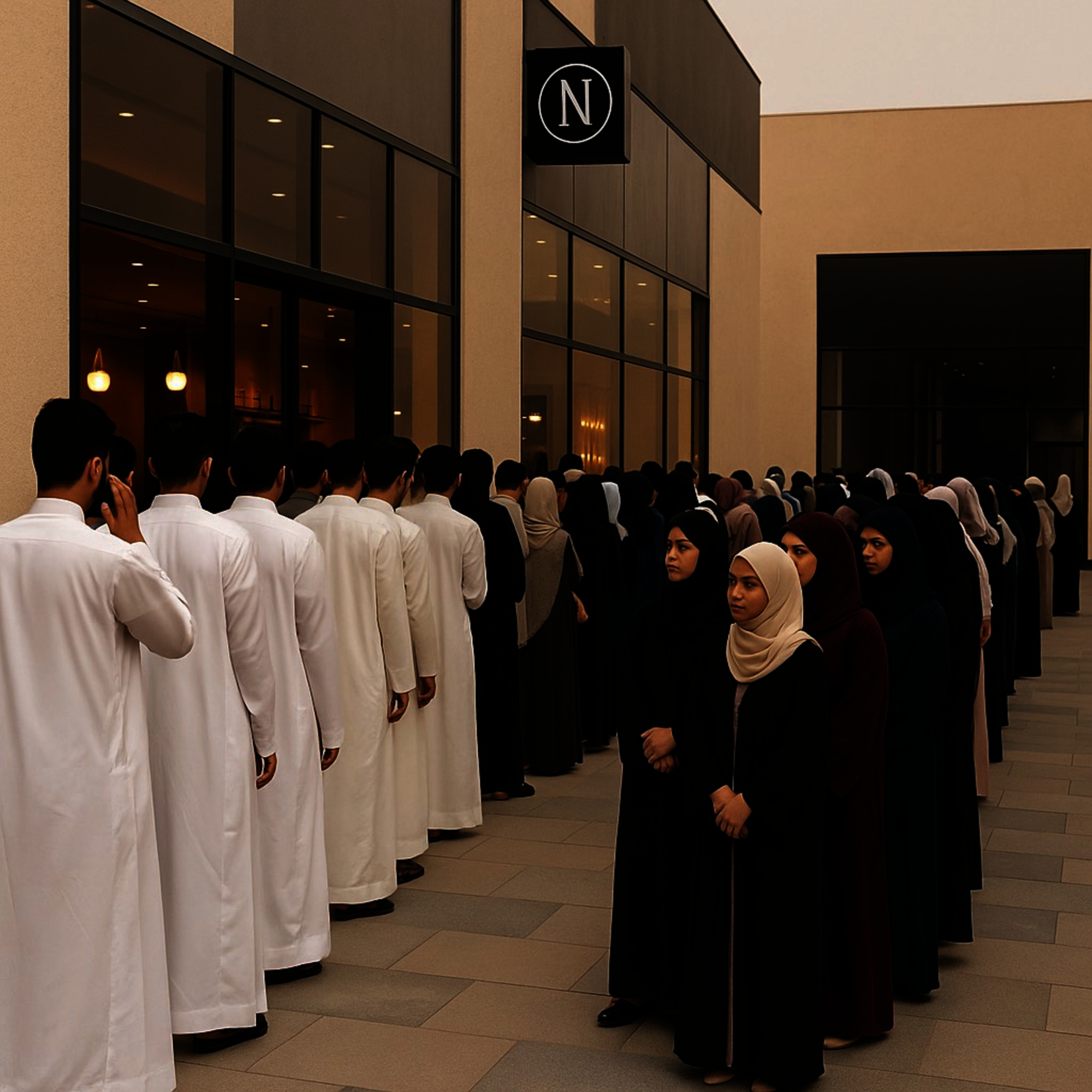






وسط حرارة الصيف، امتدّ طابور بشري أمام مقهى حديث الافتتاح. دون إعلان رسمي، دون منتجات جديدة، هنا مشهد مزدحم التقطته عدسة «السناب» لتنتقل العدوى إلى منصات التواصل الأخرى.
ويتكرر المشهد في مدن أخرى، ويغدو الزحام مقصداً بحد ذاته. لم يعد الطابور دلالة على جودة أو احتياج، بل أصبح هو المنتج بحد ذاته. إنها «هبّة اللاين»، إذ تتشابك الحاجة للظهور مع أدوات التسويق الخفي.
كيف نشأت الظاهرة؟
في عام 2019م، نشر معهد العلوم السلوكية في جامعة كولومبيا الأمريكية دراسة تؤكد أن وجود الزحام في مكان ما يحفز قرار الشراء بنسبة تصل إلى 42%. وأظهرت الدراسة أن الدماغ يربط الزحام بقيمة خفية، ويرجّح انضمام آخرين بدافع القبول الاجتماعي، لا جودة المنتج.
وهناك دراسات مماثلة أُجريت في جامعة طوكيو وجامعة كامبريدج، وجدت أن تأثير الطوابير في قرارات المستهلكين يفوق الإعلانات المباشرة بنسبة تصل إلى 33% وهذه الأرقام دفعت شركات تسويق دولية إلى الاستثمار في «الحشود المأجورة»؛ بهدف خلق الانطباع، قبل بناء التجربة.
ومع الوقت، انتقلت الظاهرة إلى فضاء القهوة والمقاهي هنا، مستفيدة من نشاط صنّاع المحتوى ومؤثري المنصات، وتحول الطابور إلى عرض بصريّ، والمنتج صار خلف الكاميرا، لا في فنجان القهوة!
واقع التجربة..
طوابير مصطنعة !
فيصل الشمري (شاب جامعي) يقول: تلقيت عرضاً من جهة تسويق محلية يشمل كوب مشروب و100 ريال مقابل الوقوف أمام المقهى لمدة 20 دقيقة. طُلب مني فقط أن أبدو منشغلاً، وأن أنشر صورة الزحام. لم يكن الهدف هو التذوق أو التجربة، بل المشاركة في خلق وهم النجاح.
أما هند سعود فتقول: يصلني بريد أسبوعي من بعض الشركات يطلب تغطية افتتاحات، هم يحددون المكان والوقت وعدد الأشخاص الذين أحضر معهم، فالتركيز دائماً على إبراز الازدحام. لم يُطلب منا تقييم النكهة أو الجودة، بل نشر صور الطابور في المقام الأول.
أروى الحماد (طالبة إعلام) تقول: شاركت في ثلاثة افتتاحات كمؤثرة مصغّرة. المطلوب منا الوقوف أمام المحل والتصوير. في إحداها، كنا 20 شخصاً تم توزيعنا لتكوين مشهد زحام عند الباب الأمامي والخلفي في آن واحد!
إشارة الدماغ:
المكان يستحق الانتظار
أخصائي علم النفس السلوكي ماجد الطريفي، يقول: إن إنشاء الحشود يُعد من أبرز أنماط التأثير اللاواعي التي تتحكم في القرارات اليومية للفرد خصوصاً في بيئات تتكثف فيها الرسائل البصرية، فالدماغ البشري مبرمج على تقليل الجهد المعرفي عند اتخاذ القرار، ويبحث دائماً عن إشارات خارجية تُختصر تحت ما يُعرف بـ«التحيّز الاجتماعي الإيجابي»؛ أي الميل لتبنّي سلوك الآخرين باعتباره مؤشراً على الصحة والدقة.
وحين يرى الفرد طابوراً أمام مكان ما، تنشط في دماغه منطقة تُعرف بالقشرة الجبهية المدارية، وهي المسؤولة عن معالجة المكافآت الاجتماعية، وتُطلق حكماً مباشراً: «هذا المكان يستحق الانتظار».
ويتابع الطريفي: في ظاهرة «هبة اللاين»، لا يتجاوب المستهلك مع المنتج، بل مع صورة الزحام حوله. فالمشهد الجماعي يمنحه شعوراً بالانتماء، ويُنشئ وهماً بأن الاختيار تم من قِبل الجماعة التي يصطفّ معها.
وهذا ما يُعرف سلوكياً بـ«الانتماء اللحظي»، اذ يختبر الفرد إحساساً بالأمان المؤقت فقط لأنه فعل ما يفعله الآخرون، والمسوقون المحترفون يدركون تماماً هذه الاستجابة العصبية، ويصممون حملاتهم لاستثارة هذه الدائرة دون الحاجة لتقديم منتج متفوّق. هنا تكمن الخطورة، إذ يجري تكييف الفرد للاستجابة إلى التمثيل البصري لا المحتوى الحقيقي.
كيف تسيطر على انفعالك؟
يشير أخصائي علم النفس السلوكي ماجد الطريفي، إلى أن التكرار المتعمد لمشهد الزحام يؤدي إلى ما يسميه علماء النفس بـ«تطبيع الانطباع»، اذ يُعاد برمجة المستهلك على اتخاذ قراراته انطلاقاً من الصور لا من التقييم الداخلي في المدى القصير، يبدو هذا السلوك آمناً، لكنّه يضعف آلية التقييم الذاتي، ويجعل الأفراد عُرضة لاستهلاك متكرر قائم على الانفعال لا على التحليل، والوعي بهذه الظاهرة لا يحتاج إلى تحذير مباشر، بل إلى تدخل معرفي يعيد تنظيم العلاقة بين الإدراك الظاهري والقيمة الفعلية، ويُعيد للفرد سيطرته على قراره، بعيداً عن سلوك القطيع المصمم مسبقاً..
هلع أخلاقي..
وتوهم بالجدارة
المستشار الاجتماعي والباحث المتخصص عبدالله البقعاوي، يرى أن الطوابير التي نراها أمام المقاهي السعودية لا يمكن تفسيرها بمفهوم الحاجة الاستهلاكية، بل بالانجذاب، فالفرد في هذا السياق لا يبحث عن منتج، بل عن مشهد ينتمي إليه، وعن لحظة يمكن توثيقها لا استهلاكها، وهناك دراسات سوسيولوجية عالمية، منها ما نشره عالم الاجتماع الكندي جويل بيست، في تحليله لظواهر الهلع الأخلاقي، تشير إلى أن الجماهير كثيراً ما تستجيب لمشاهد التجمهر؛ لأنها تُضفي شعوراً بالجدارة، حتى عندما يغيب الفهم الكامل لما يحدث فالصورة الجماعية تُصبح ضماناً بأن «الشيء يستحق»، حتى إن لم تُفهم ماهيته.
ويضيف: هذا ما يحدث تماماً في «هبة اللاين» فالطابور هنا لا يدل على الجودة، بل على القيمة الرمزية للانضمام إلى مشهد يُعاد إنتاجه رقمياً والفرد ينخرط في الاصطفاف لأنه يريد أن يُرى، لا لأنه يحتاج إلى ما ينتظر. هذا يُشبه ما وصفه إرفينغ غوفمان، في مفهوم «العرض الاجتماعي»، إذ يتحول السلوك العام إلى أداء يحكمه التفاعل مع توقعات الآخرين، لا مع القناعة الذاتية.
ما يراه الآخرون
لا ما يراه الفرد!
يستطرد البقعاوي: في مجتمعنا اليوم، خصوصاً بين الفئات الشابة، بدأت الرموز المرئية تأخذ موقعاً متقدّماً على القيم الجوهرية. الطابور المصوَّر أمام مقهى يُمنح وزناً اجتماعياً يفوق أحياناً محتوى المنتج نفسه، وهو ما يعكس هيمنة ما يُعرف في علم الاجتماع الثقافي بـ«التأثير الرأسي للمحتوى»، اذ يختار الفرد ما يراه الآخرون لا ما يراه هو جديراً بالاختيار.
ومن زاوية مجتمعية، يمكن القول إن «هبة اللاين» لا تعبّر عن خلل استهلاكي فقط، بل عن فجوة في بناء الهوية الفردية في ظل طغيان التفاعل اللحظي، فالفرد لم يعد يبحث عن ذاته داخل التجربة، بل يبحث عن ذاته في ردود أفعال الآخرين على التجربة.
ويختم الباحث المتخصص البقعاوي بالقول: إن تجاوز هذه الظاهرة لا يتحقق بالمنع أو الرقابة، بل بترسيخ قيم الاستقلالية في التقييم، وتمكين الأفراد من قراءة المشهد خارج إطاره المصوّر، ليعود الفعل الاستهلاكي إلى مساره الطبيعي: من الحاجة إلى المنتج، لا من الانجذاب إلى الصورة.
السقوط في «مشهدية الحشود»
في رأي المستشار الاقتصادي عيد العيد أن «هبة اللاين» تُعبّر في جوهرها عن حالة تضخم انطباعي؛ وهي إحدى أخطر صور الخلل في تقييم القيمة السوقية، اذ تُبنى السمعة التجارية على انطباع بصري آنيٍّ لا على أساس اقتصادي حقيقي، وتضخّم الانطباع يحدث عندما تتجاوز صورة الطلب الظاهري قدرة المنتج على خلق تكرار شرائي حقيقي، فيبدو المشروع ناجحاً في بدايته، ثم ينهار سريعاً حين يُختبر في دورة السوق الطبيعية.
وخلال السنوات الماضية، سجّلت تقارير اقتصادية دولية -منها تقرير معهد CBInsights حول فشل الشركات الناشئة (2022)-: إن أكثر من 14% من المشاريع الترفيهية والتجارية التي حققت إقبالاً جماهيرياً سريعاً، انهارت بعد أقل من عام؛ بسبب اعتمادها على دعاية مبنية على «مشهدية الحشود»، دون استراتيجية ولاء أو منتج مستدام.
وتابع العيد في السياق السعودي، لوحظ في أكثر من مدينة أن بعض المقاهي الحديثة التي اعتمدت أسلوب الطوابير المدفوعة ارتفعت مبيعاتها بنسبة 30 إلى 45% خلال الأسبوع الأول، لكنها فقدت أكثر من 60% من زوارها خلال الشهر التالي، وهذا لا يُعد تراجعاً عارضاً، بل يُعد مؤشراً واضحاً على أن الطلب تم دفعه بعوامل خارجية غير قابلة للتكرار.
فشل التضخم الجماهيري المصطنع
المستشار الاقتصادي عيد العيد، يواصل تحليله، ويضيف: اقتصادياً يمكن تشبيه «هبة اللاين» بموجات المضاربة في أسواق الأصول غير المنتجة، إذ يشتري الناس الانطباع لا الأصل، ويتفاعل الناس مع السعر لا مع القيمة. وما يحدث هنا أن الزبون يشتري المشهد لا المشروب، فالسوق العادل يُبنى على وضوح المؤشرات. وعندما تصبح الطوابير أداة دعائية بلا شفافية، فإنها تُعطّل آليات العرض والطلب، وتضر بالمشاريع الصغيرة ذات القيمة الفعلية، التي لا تملك ميزانية لتأجير طوابير ولا لترويج بصري مفتعل.
والتوازن يحتاج إلى أمرين: أدوات ضبط تنظيمي تحكم الإعلانات غير المباشرة وتلزم بالإفصاح، ووعي استهلاكي يفرّق بين قيمة التجربة وقيمة الزحام، فالمستهلك حين يدفع لقاء الانطباع، لا يعود. والمقهى الذي يُبنى على صورة لا يبني علاقة. هذه قاعدة لا تحتاج أكثر من دورة محاسبية واحدة لتُثبت فشل «التضخم الجماهيري المصطنع» في الاستدامة التجارية
الصورة الخادعة..
نص كاذب!
المستشار القانوني والمحامي سلمان الرمالي، يشدد على أن الإعلانات التي تُخفي صفتها الترويجية تُعد مخالفة واضحة للمادة الثالثة من نظام التجارة الإلكترونية في السعودية، التي تشترط الإفصاح الكامل عن أي علاقة تجارية، فالطوابير المدفوعة تدخل ضمن الإعلان غير المباشر، ويجب الإقرار بها. وفي حال إثبات التواطؤ بين الشركة وصانع المحتوى من دون إفصاح، تُحمّل المسؤولية للطرفين. ويُعد هذا السلوك تضليلاً يترتب عليه غرامات وعقوبات تصل إلى واحد مليون ريال حسب تصنيف المخالفة. والنظام لا يميّز بين المحلات الإلكترونية والواقعية حين تُستخدم المنصات الرقمية كأداة ترويج. الإعلان المضلل يُحاسب أينما وُجد، والصورة التي تخدع المستهلك تُعامل كالنص الكاذب تماماً في نظر القانون.
الدخول في باب التمثيل والتضليل
وترى الباحثة القانونية في الإعلام التجاري هيا السليمان، أن الزحام المأجور يفتقر إلى الشفافية، ويقوّض حق المستهلك في اتخاذ قرار مبني على الوقائع. «هناك فراغ تنظيمي في تصنيف هذا النوع من الحملات، رغم تكراره في القطاع الترفيهي والمقاهي تحديداً، والمطلوب لوائح فرعية تلزم بالإفصاح عن المكون البشري المصطنع في الحضور كما يحدث في الإعلانات المرئية عند ظهور ممثلين مدفوعي الأجر».
أما المهتم بشأن حماية المستهلك حمدان التومي، فيقول: إن بعض المحلات تعتمد الطابور المدفوع تكتيكاً تسويقيّاً رئيسيّاً، وتعمل على رفع الأسعار لاحقاً على أساس وهمي، وهذا النوع من التلاعب يؤدي إلى غياب العدالة في السوق، ويجب أن يدخل ضمن رقابة هيئة المنافسة وحماية المستهلك. وهناك منشآت صغيرة بدأت تعتمد هذا النموذج لتبدو منافسة، لكنها تدخل في باب التضليل والتمثيل.
«ترند سعري».. ووهم مرئي
أستاذ المالية والتسويق الدكتور وليد الغصاب يقول: إن الولاء الحقيقي ينشأ من تجربة مستدامة، لا من «ثرثرة الزحام» اللحظي، فالطوابير المدفوعة تقدم دفعة أولية في المبيعات، لكنها تخلو تماماً من أساس صلب لبناء علاقة مستمرة مع العميل. وأضاف: إن اتباع الشركات لهذا المنهج يجعل السبب الفعلي لزيارة المستهلك ليس المنتج أو الخدمة، بل المشهد الظاهري، وهو ما يشبه «الترند السلعي»، الذي يعتمد على تأثير اللحظة لا الجوهر. وفي هذا الإطار، كشفت دراسة لمؤسسة ماكنزي أن المستهلكين الذين يزورون أماكن نتيجة ترند بصري، أكثرهم لا يعود. وتشير بياناتها إلى أن نسبة العودة تقل إلى 12% فقط بعد أول تجربة ومقارنة تجربة العملاء في البرامج المدفوعة للولاء -حسب ماكنزي- توضح الفارق الجذري، فتلك البرامج تحفّز الإنفاق المتكرر وتبني تفاعلاً عاطفياً مع العلامة عبر مزايا ملموسة، وتنظيم جماعي، وتجربة محسنة، ما يعزز الاحتفاظ بالعميل بنحو 60% مقارنة بالبرامج المجانية، فالبناء هنا يأتي من قيمة يعترف بها العميل شخصياً، لا من وهم مرئي يصنّعه التسويق بالزوايا.
أما في حالة «هبة اللاين»، فإن الطابور يُستأجر في البداية لخلق انطباع بصري مؤقت، وغالباً ما تنهار أعداد الزبائن في الأسابيع القليلة التالية، ما يشير بوضوح إلى وجود هشاشة تسويقية، إذ يصطدم التسويق بالزمن الحقيقي، فيؤدي إلى تضخّم لحظي في المبيعات، لكنه يتراجع دون خطة لجذب العملاء غذائياً أو اجتماعياً.
الحل في المحتوى الواقعي
لضبط الظاهرة يوصي أستاذ المالية الدكتور وليد الغصاب، بالفصل بين الانطباع والمضمون: الاستثمار في المنتج، الجودة، تجربة العميل، وبيئة الخدمة بدلاً من الاعتماد على الزحام الوهمي. وبرامج ولاء حقيقية: وفق نماذج مثل CVS CarePass أو اشتراك Lululemon، تركز على مزايا ملموسة وتجربة متكررة وتقويم الأداء الحقيقي ومراقبة معدل العودة ومؤشرات الرضا الفعلي بدل التركيز فقط على أرقام الزيارات الأولى والشفافية التسويقية والتحذير من استخدام صور ومحتوى زائف لتضليل المستهلكين، اللجوء إلى محتوى واقعي يدعم القيم الجوهرية للعلامة.
القهوة أم الطابور؟
«هبة اللاين» تحوّلت إلى استراتيجية تسويق رمادية، تتقاطع فيها الصورة مع الغريزة، وتتوارى فيها الشفافية خلف عدسات الهواتف والمشهد يتطلب أكثر من فضح الممارسات، بل يحتاج إلى تشريعات حديثة، ووعي جمعي، وإعلام متخصص يكشف الوجه الحقيقي لما يُعرض على أنه نجاح، بينما هو في جوهره «طابور مموّل» في زمن الاقتصاد البصري، لا بد من سؤال دائم: هل نحن نشتري القهوة أم نشتري الطابور؟
استطلاع
أجرت «عكاظ»، استطلاعاً ميدانياً في ثلاث مناطق: الرياض، القصيم، وحائل. شمل 150 مشاركاً من مختلف الفئات العمرية، راوحت أعمارهم بين 19 و45 عاماً، بينهم 40 امرأة، وجاءت نتائج الاستطلاع كالتالي:
61 % زاروا مقهى بسبب زحام رأوه على وسائل التواصل
35 % شعروا بخيبة بعد الزيارة وقرروا عدم العودة
73 % أكدوا أن مشاهد الطوابير تؤثر في قرارهم بالشراء
82 % لم يكونوا على علم بأن بعض الطوابير مفتعلة
«عكاظ» تفضح «الحشود المأجورة»..
«هبّة اللاين» نشتري القهوة أم نشتري الطابور ؟!
11 يوليو 2025 - 08:53
|
آخر تحديث 11 يوليو 2025 - 08:53


تابع قناة عكاظ على الواتساب
متعب العواد (حائل) Motabalawwd@
In the heat of summer, a human queue stretched in front of a newly opened café. Without an official announcement, without new products, here was a crowded scene captured by a "snap" lens, spreading the trend to other social media platforms.
The scene repeats in other cities, and the crowd itself becomes a destination. The queue is no longer an indication of quality or need; it has become the product itself. This is the "Line Fever," where the need to appear intertwines with tools of covert marketing.
How did the phenomenon arise?
In 2019, the Behavioral Science Institute at Columbia University published a study confirming that the presence of a crowd in a place can stimulate the purchasing decision by up to 42%. The study showed that the brain associates crowds with hidden value, and it is likely that others join out of social acceptance rather than product quality.
Similar studies conducted at the University of Tokyo and the University of Cambridge found that the impact of queues on consumer decisions exceeds direct advertisements by up to 33%. These figures prompted international marketing companies to invest in "paid crowds" to create an impression before building the experience.
Over time, the phenomenon moved into the coffee and café space here, benefiting from the activity of content creators and platform influencers. The queue turned into a visual display, and the product became behind the camera, not in the coffee cup!
The reality of the experience..
Artificial queues!
Faisal Al-Shammari (a university student) says: I received an offer from a local marketing agency that included a drink and 100 riyals in exchange for standing in front of the café for 20 minutes. I was only asked to look busy and to post a picture of the crowd. The goal was not to taste or experience, but to participate in creating the illusion of success.
Hind Saud says: I receive weekly emails from some companies requesting coverage of openings; they specify the location, time, and the number of people I should bring with me, as the focus is always on highlighting the crowd. We were not asked to evaluate the flavor or quality, but to post pictures of the queue first and foremost.
Arwa Al-Hamad (a media student) says: I participated in three openings as a micro-influencer. We were required to stand in front of the store and take pictures. In one of them, we were 20 people distributed to create a crowd scene at both the front and back doors simultaneously!
The brain's signal:
The place is worth the wait
Behavioral psychologist Majid Al-Turaifi says: Creating crowds is one of the most prominent patterns of unconscious influence that control an individual's daily decisions, especially in environments saturated with visual messages. The human brain is programmed to reduce cognitive effort when making decisions and always looks for external signals summarized under what is known as "positive social bias"; that is, the tendency to adopt the behavior of others as an indicator of health and accuracy.
When an individual sees a queue in front of a place, an area in their brain known as the orbital frontal cortex is activated, which is responsible for processing social rewards, and it releases a direct judgment: "This place is worth the wait."
Al-Turaifi continues: In the "Line Fever" phenomenon, the consumer does not respond to the product but to the image of the crowd around them. The collective scene gives them a sense of belonging and creates the illusion that the choice was made by the group they are standing with.
This is behaviorally known as "momentary belonging," where the individual experiences a temporary sense of security simply because they are doing what others are doing. Professional marketers are fully aware of this neural response and design their campaigns to stimulate this circuit without needing to offer a superior product. Here lies the danger, as the individual is conditioned to respond to the visual representation rather than the actual content.
How do you control your emotions?
Behavioral psychologist Majid Al-Turaifi points out that the deliberate repetition of the crowd scene leads to what psychologists call "normalizing the impression," as the consumer is reprogrammed to make decisions based on images rather than internal evaluation. In the short term, this behavior seems safe, but it weakens the self-evaluation mechanism and makes individuals susceptible to repeated consumption based on emotion rather than analysis. Awareness of this phenomenon does not require direct warning but rather cognitive intervention that reorganizes the relationship between apparent perception and actual value, restoring the individual's control over their decision, away from the pre-designed herd behavior.
Ethical panic..
And an illusion of worthiness
Social consultant and researcher Abdullah Al-Buqai says that the queues we see in front of Saudi cafés cannot be explained by the concept of consumer need, but rather by attraction. In this context, the individual is not looking for a product but for a scene to belong to, and for a moment that can be documented rather than consumed. Global sociological studies, including those published by Canadian sociologist Joel Best in his analysis of moral panic phenomena, indicate that crowds often respond to scenes of gathering because they confer a sense of worthiness, even when there is a lack of full understanding of what is happening. The collective image becomes a guarantee that "the thing is worth it," even if its nature is not understood.
He adds: This is exactly what happens in "Line Fever"; the queue here does not indicate quality but rather the symbolic value of joining a digitally reproduced scene, and the individual engages in the lineup because they want to be seen, not because they need what they are waiting for. This resembles what Erving Goffman described in the concept of "social performance," where public behavior becomes a performance governed by interaction with the expectations of others, not with self-conviction.
What others see
Not what the individual sees!
Al-Buqai continues: In our society today, especially among young people, visual symbols have begun to take precedence over core values. The photographed queue in front of a café is granted social weight that sometimes exceeds the content of the product itself, reflecting the dominance of what is known in cultural sociology as "the vertical influence of content," where the individual chooses what others see rather than what they deem worthy of choice.
From a societal perspective, it can be said that "Line Fever" does not only express a consumer malfunction but also a gap in building individual identity in light of the dominance of momentary interaction. The individual no longer seeks their self within the experience but seeks their self in the reactions of others to the experience.
The specialized researcher Al-Buqai concludes by saying: Overcoming this phenomenon cannot be achieved through prohibition or censorship but by instilling values of independence in evaluation, enabling individuals to read the scene outside its photographed frame, allowing consumer action to return to its natural course: from the need for the product, not from the attraction to the image.
Falling into the "crowd scene"
In the opinion of economic consultant Eid Al-Eid, "Line Fever" essentially expresses a state of impression inflation; it is one of the most dangerous forms of dysfunction in evaluating market value, as commercial reputation is built on a fleeting visual impression rather than on real economic foundations. Impression inflation occurs when the apparent demand image exceeds the product's ability to create real purchasing repetition, making the project seem successful at first but then collapsing quickly when tested in the natural market cycle.
In recent years, international economic reports - including the CBInsights report on the failure of startups (2022) - have recorded that more than 14% of entertainment and commercial projects that achieved rapid public interest collapsed after less than a year due to relying on advertising based on "crowd scenes," without a loyalty strategy or sustainable product.
In the Saudi context, Al-Eid noted that in more than one city, some modern cafés that adopted the paid queue method saw their sales rise by 30 to 45% during the first week, but lost more than 60% of their visitors in the following month. This is not considered a temporary decline but a clear indicator that demand was driven by external factors that are not repeatable.
Failure of artificial crowd inflation
Economic consultant Eid Al-Eid continues his analysis, adding: Economically, "Line Fever" can be likened to speculative waves in non-productive asset markets, where people buy the impression rather than the essence, and people react to the price rather than the value. What happens here is that the customer buys the scene, not the drink. A fair market is built on clear indicators. When queues become a promotional tool without transparency, they disrupt the mechanisms of supply and demand and harm small projects with actual value that do not have a budget to hire queues or promote artificial visuals.
Balance requires two things: regulatory control tools that govern indirect advertising and mandate disclosure, and consumer awareness that distinguishes between the value of experience and the value of crowding. When the consumer pays for the impression, they do not return. A café built on an image does not build a relationship. This is a rule that requires no more than one accounting cycle to prove the failure of "artificial crowd inflation" in commercial sustainability.
The deceptive image..
A false text!
Legal consultant and lawyer Salman Al-Ramali emphasizes that advertisements that conceal their promotional nature are a clear violation of Article 3 of the e-commerce law in Saudi Arabia, which requires full disclosure of any commercial relationship. Paid queues fall under indirect advertising and must be acknowledged. If collusion between the company and the content creator is proven without disclosure, both parties are held responsible. This behavior is considered misleading, resulting in fines and penalties of up to one million riyals according to the classification of the violation. The law does not distinguish between online and physical stores when digital platforms are used as a promotional tool. Misleading advertising is penalized wherever it exists, and an image that deceives the consumer is treated as a false text in the eyes of the law.
Entering the realm of representation and deception
Legal researcher in commercial media Haya Al-Sulaiman believes that paid crowds lack transparency and undermine the consumer's right to make a decision based on facts. "There is a regulatory vacuum in classifying this type of campaign, despite its repetition in the entertainment sector and cafés specifically. What is needed are subsidiary regulations that mandate the disclosure of the artificial human component in attendance, as happens in visual advertisements when paid representatives appear."
Consumer protection advocate Hamdan Al-Toumi says that some stores rely on paid queues as a primary marketing tactic and later raise prices based on an illusion. This type of manipulation leads to a lack of fairness in the market and should fall under the supervision of the Competition and Consumer Protection Authority. Some small establishments have begun to adopt this model to appear competitive, but they fall into the realm of deception and representation.
"Price trend".. and a visual illusion
Finance and marketing professor Dr. Walid Al-Ghasab says that true loyalty arises from a sustainable experience, not from the "chatter of momentary crowds." Paid queues provide an initial boost in sales but lack a solid foundation for building a lasting relationship with the customer. He added: Companies following this approach make the actual reason for the consumer's visit not the product or service, but the apparent scene, which resembles a "commodity trend" that relies on the impact of the moment rather than the essence. In this context, a study by McKinsey revealed that consumers who visit places due to a visual trend are mostly those who do not return. Its data indicates that the return rate drops to only 12% after the first experience, and comparing customer experiences in paid loyalty programs - according to McKinsey - highlights the fundamental difference, as those programs stimulate repeat spending and build an emotional interaction with the brand through tangible benefits, collective organization, and enhanced experience, which increases customer retention by about 60% compared to free programs. Here, the building comes from a value recognized by the customer personally, not from a visual illusion manufactured by marketing angles.
In the case of "Line Fever," the queue is initially rented to create a temporary visual impression, and customer numbers often collapse in the following weeks, clearly indicating marketing fragility, as marketing collides with real-time, leading to momentary inflation in sales, but it recedes without a plan to attract customers nutritionally or socially.
The solution lies in real content
To regulate the phenomenon, finance professor Dr. Walid Al-Ghasab recommends separating impression from substance: investing in the product, quality, customer experience, and service environment instead of relying on illusory crowds. Real loyalty programs: according to models like CVS CarePass or Lululemon subscription, focus on tangible benefits, repeated experiences, actual performance evaluation, and monitoring return rates and actual satisfaction indicators instead of focusing solely on first visit numbers and marketing transparency, and warning against using false images and content to mislead consumers, resorting to real content that supports the core values of the brand.
Coffee or the queue?
"Line Fever" has turned into a gray marketing strategy, where the image intersects with instinct, and transparency hides behind phone lenses, and the scene requires more than just exposing practices; it needs modern legislation, collective awareness, and specialized media to reveal the true face of what is presented as success, while it is essentially a "funded queue" in the era of visual economy. There must always be a question: Are we buying coffee or are we buying the queue?
Survey
Okaz conducted a field survey in three regions: Riyadh, Qassim, and Hail. It included 150 participants from various age groups, ranging from 19 to 45 years old, including 40 women. The results of the survey were as follows:
61% visited a café due to a crowd they saw on social media.
35% felt disappointed after the visit and decided not to return.
73% confirmed that scenes of queues influence their purchasing decision.
82% were unaware that some queues were fabricated.
The scene repeats in other cities, and the crowd itself becomes a destination. The queue is no longer an indication of quality or need; it has become the product itself. This is the "Line Fever," where the need to appear intertwines with tools of covert marketing.
How did the phenomenon arise?
In 2019, the Behavioral Science Institute at Columbia University published a study confirming that the presence of a crowd in a place can stimulate the purchasing decision by up to 42%. The study showed that the brain associates crowds with hidden value, and it is likely that others join out of social acceptance rather than product quality.
Similar studies conducted at the University of Tokyo and the University of Cambridge found that the impact of queues on consumer decisions exceeds direct advertisements by up to 33%. These figures prompted international marketing companies to invest in "paid crowds" to create an impression before building the experience.
Over time, the phenomenon moved into the coffee and café space here, benefiting from the activity of content creators and platform influencers. The queue turned into a visual display, and the product became behind the camera, not in the coffee cup!
The reality of the experience..
Artificial queues!
Faisal Al-Shammari (a university student) says: I received an offer from a local marketing agency that included a drink and 100 riyals in exchange for standing in front of the café for 20 minutes. I was only asked to look busy and to post a picture of the crowd. The goal was not to taste or experience, but to participate in creating the illusion of success.
Hind Saud says: I receive weekly emails from some companies requesting coverage of openings; they specify the location, time, and the number of people I should bring with me, as the focus is always on highlighting the crowd. We were not asked to evaluate the flavor or quality, but to post pictures of the queue first and foremost.
Arwa Al-Hamad (a media student) says: I participated in three openings as a micro-influencer. We were required to stand in front of the store and take pictures. In one of them, we were 20 people distributed to create a crowd scene at both the front and back doors simultaneously!
The brain's signal:
The place is worth the wait
Behavioral psychologist Majid Al-Turaifi says: Creating crowds is one of the most prominent patterns of unconscious influence that control an individual's daily decisions, especially in environments saturated with visual messages. The human brain is programmed to reduce cognitive effort when making decisions and always looks for external signals summarized under what is known as "positive social bias"; that is, the tendency to adopt the behavior of others as an indicator of health and accuracy.
When an individual sees a queue in front of a place, an area in their brain known as the orbital frontal cortex is activated, which is responsible for processing social rewards, and it releases a direct judgment: "This place is worth the wait."
Al-Turaifi continues: In the "Line Fever" phenomenon, the consumer does not respond to the product but to the image of the crowd around them. The collective scene gives them a sense of belonging and creates the illusion that the choice was made by the group they are standing with.
This is behaviorally known as "momentary belonging," where the individual experiences a temporary sense of security simply because they are doing what others are doing. Professional marketers are fully aware of this neural response and design their campaigns to stimulate this circuit without needing to offer a superior product. Here lies the danger, as the individual is conditioned to respond to the visual representation rather than the actual content.
How do you control your emotions?
Behavioral psychologist Majid Al-Turaifi points out that the deliberate repetition of the crowd scene leads to what psychologists call "normalizing the impression," as the consumer is reprogrammed to make decisions based on images rather than internal evaluation. In the short term, this behavior seems safe, but it weakens the self-evaluation mechanism and makes individuals susceptible to repeated consumption based on emotion rather than analysis. Awareness of this phenomenon does not require direct warning but rather cognitive intervention that reorganizes the relationship between apparent perception and actual value, restoring the individual's control over their decision, away from the pre-designed herd behavior.
Ethical panic..
And an illusion of worthiness
Social consultant and researcher Abdullah Al-Buqai says that the queues we see in front of Saudi cafés cannot be explained by the concept of consumer need, but rather by attraction. In this context, the individual is not looking for a product but for a scene to belong to, and for a moment that can be documented rather than consumed. Global sociological studies, including those published by Canadian sociologist Joel Best in his analysis of moral panic phenomena, indicate that crowds often respond to scenes of gathering because they confer a sense of worthiness, even when there is a lack of full understanding of what is happening. The collective image becomes a guarantee that "the thing is worth it," even if its nature is not understood.
He adds: This is exactly what happens in "Line Fever"; the queue here does not indicate quality but rather the symbolic value of joining a digitally reproduced scene, and the individual engages in the lineup because they want to be seen, not because they need what they are waiting for. This resembles what Erving Goffman described in the concept of "social performance," where public behavior becomes a performance governed by interaction with the expectations of others, not with self-conviction.
What others see
Not what the individual sees!
Al-Buqai continues: In our society today, especially among young people, visual symbols have begun to take precedence over core values. The photographed queue in front of a café is granted social weight that sometimes exceeds the content of the product itself, reflecting the dominance of what is known in cultural sociology as "the vertical influence of content," where the individual chooses what others see rather than what they deem worthy of choice.
From a societal perspective, it can be said that "Line Fever" does not only express a consumer malfunction but also a gap in building individual identity in light of the dominance of momentary interaction. The individual no longer seeks their self within the experience but seeks their self in the reactions of others to the experience.
The specialized researcher Al-Buqai concludes by saying: Overcoming this phenomenon cannot be achieved through prohibition or censorship but by instilling values of independence in evaluation, enabling individuals to read the scene outside its photographed frame, allowing consumer action to return to its natural course: from the need for the product, not from the attraction to the image.
Falling into the "crowd scene"
In the opinion of economic consultant Eid Al-Eid, "Line Fever" essentially expresses a state of impression inflation; it is one of the most dangerous forms of dysfunction in evaluating market value, as commercial reputation is built on a fleeting visual impression rather than on real economic foundations. Impression inflation occurs when the apparent demand image exceeds the product's ability to create real purchasing repetition, making the project seem successful at first but then collapsing quickly when tested in the natural market cycle.
In recent years, international economic reports - including the CBInsights report on the failure of startups (2022) - have recorded that more than 14% of entertainment and commercial projects that achieved rapid public interest collapsed after less than a year due to relying on advertising based on "crowd scenes," without a loyalty strategy or sustainable product.
In the Saudi context, Al-Eid noted that in more than one city, some modern cafés that adopted the paid queue method saw their sales rise by 30 to 45% during the first week, but lost more than 60% of their visitors in the following month. This is not considered a temporary decline but a clear indicator that demand was driven by external factors that are not repeatable.
Failure of artificial crowd inflation
Economic consultant Eid Al-Eid continues his analysis, adding: Economically, "Line Fever" can be likened to speculative waves in non-productive asset markets, where people buy the impression rather than the essence, and people react to the price rather than the value. What happens here is that the customer buys the scene, not the drink. A fair market is built on clear indicators. When queues become a promotional tool without transparency, they disrupt the mechanisms of supply and demand and harm small projects with actual value that do not have a budget to hire queues or promote artificial visuals.
Balance requires two things: regulatory control tools that govern indirect advertising and mandate disclosure, and consumer awareness that distinguishes between the value of experience and the value of crowding. When the consumer pays for the impression, they do not return. A café built on an image does not build a relationship. This is a rule that requires no more than one accounting cycle to prove the failure of "artificial crowd inflation" in commercial sustainability.
The deceptive image..
A false text!
Legal consultant and lawyer Salman Al-Ramali emphasizes that advertisements that conceal their promotional nature are a clear violation of Article 3 of the e-commerce law in Saudi Arabia, which requires full disclosure of any commercial relationship. Paid queues fall under indirect advertising and must be acknowledged. If collusion between the company and the content creator is proven without disclosure, both parties are held responsible. This behavior is considered misleading, resulting in fines and penalties of up to one million riyals according to the classification of the violation. The law does not distinguish between online and physical stores when digital platforms are used as a promotional tool. Misleading advertising is penalized wherever it exists, and an image that deceives the consumer is treated as a false text in the eyes of the law.
Entering the realm of representation and deception
Legal researcher in commercial media Haya Al-Sulaiman believes that paid crowds lack transparency and undermine the consumer's right to make a decision based on facts. "There is a regulatory vacuum in classifying this type of campaign, despite its repetition in the entertainment sector and cafés specifically. What is needed are subsidiary regulations that mandate the disclosure of the artificial human component in attendance, as happens in visual advertisements when paid representatives appear."
Consumer protection advocate Hamdan Al-Toumi says that some stores rely on paid queues as a primary marketing tactic and later raise prices based on an illusion. This type of manipulation leads to a lack of fairness in the market and should fall under the supervision of the Competition and Consumer Protection Authority. Some small establishments have begun to adopt this model to appear competitive, but they fall into the realm of deception and representation.
"Price trend".. and a visual illusion
Finance and marketing professor Dr. Walid Al-Ghasab says that true loyalty arises from a sustainable experience, not from the "chatter of momentary crowds." Paid queues provide an initial boost in sales but lack a solid foundation for building a lasting relationship with the customer. He added: Companies following this approach make the actual reason for the consumer's visit not the product or service, but the apparent scene, which resembles a "commodity trend" that relies on the impact of the moment rather than the essence. In this context, a study by McKinsey revealed that consumers who visit places due to a visual trend are mostly those who do not return. Its data indicates that the return rate drops to only 12% after the first experience, and comparing customer experiences in paid loyalty programs - according to McKinsey - highlights the fundamental difference, as those programs stimulate repeat spending and build an emotional interaction with the brand through tangible benefits, collective organization, and enhanced experience, which increases customer retention by about 60% compared to free programs. Here, the building comes from a value recognized by the customer personally, not from a visual illusion manufactured by marketing angles.
In the case of "Line Fever," the queue is initially rented to create a temporary visual impression, and customer numbers often collapse in the following weeks, clearly indicating marketing fragility, as marketing collides with real-time, leading to momentary inflation in sales, but it recedes without a plan to attract customers nutritionally or socially.
The solution lies in real content
To regulate the phenomenon, finance professor Dr. Walid Al-Ghasab recommends separating impression from substance: investing in the product, quality, customer experience, and service environment instead of relying on illusory crowds. Real loyalty programs: according to models like CVS CarePass or Lululemon subscription, focus on tangible benefits, repeated experiences, actual performance evaluation, and monitoring return rates and actual satisfaction indicators instead of focusing solely on first visit numbers and marketing transparency, and warning against using false images and content to mislead consumers, resorting to real content that supports the core values of the brand.
Coffee or the queue?
"Line Fever" has turned into a gray marketing strategy, where the image intersects with instinct, and transparency hides behind phone lenses, and the scene requires more than just exposing practices; it needs modern legislation, collective awareness, and specialized media to reveal the true face of what is presented as success, while it is essentially a "funded queue" in the era of visual economy. There must always be a question: Are we buying coffee or are we buying the queue?
Survey
Okaz conducted a field survey in three regions: Riyadh, Qassim, and Hail. It included 150 participants from various age groups, ranging from 19 to 45 years old, including 40 women. The results of the survey were as follows:
61% visited a café due to a crowd they saw on social media.
35% felt disappointed after the visit and decided not to return.
73% confirmed that scenes of queues influence their purchasing decision.
82% were unaware that some queues were fabricated.