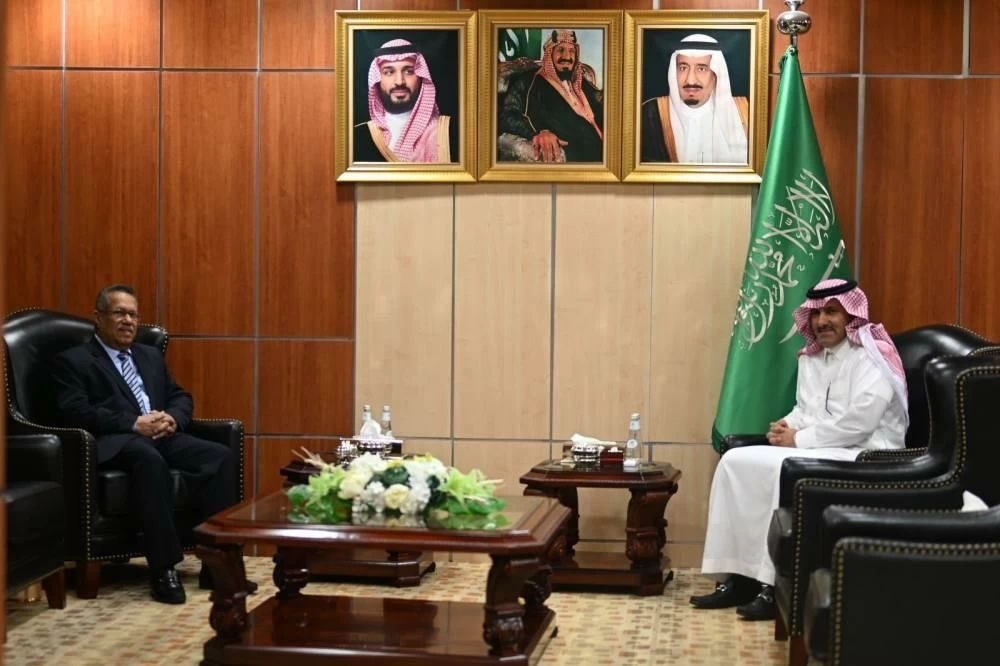
أكد رئيس مجلس الشورى اليمني الدكتور أحمد عبيد بن دغر، أن السعودية كانت وما زالت الشقيق الأكبر، والسند لليمن عند الملمات وفي كل الظروف التي تتطلب حضور الأخ عند أخيه. وقال إن السعودية كانت حاضرة دائماً في كل الظروف التي تتطلب حضور الأخ عند أخيه، بحكم ما يربط البلدين من علاقات متينة ذات أبعاد سياسية واقتصادية وأمنية، يعلمها شعبا البلدين وترعاها القيادتان، ويكفي القول إن ما يضر المملكة يضرنا في اليمن، وما ينفعها ينفعنا، وأمنها هو أمننا.
رئيس مجلس القيادة الرئاسي رشاد العليمي مستقبلاً رئيس مجلس الشورى الدكتور أحمد بن دغر.
وأوضح في حوار أجرته معه «عكاظ»، أنه ما كان يمكن لمجلس الأمن أن يعطي اليمن القرار 2216 الذي أصبح لاحقاً مرجعاً من مرجعيات الحل السياسي في اليمن لولا دعم ومساندة السعودية، التي تحظى بمكانة وتتمتع بحضور دولي كبير سمح بقرار كهذا. وقال إن هذا الحضور الإقليمي والدولي للسعودية «وحّد المجتمع الدولي خلف التحالف العربي بقيادتها لمناصرة الشرعية، وهنا تجلى الدور المركزي للمملكة في الإقليم وفي العالم».
وأشار بن دغر إلى أن المساعدات السعودية شملت مجالات عديدة مدنية وعسكرية، وأمنية، واقتصادية وإغاثية بطابع إنساني، وتنموية في صورة مشاريع بنيوية، بلغت عشرات المليارات، كانت حزمة الدعم الأخير الـ224 مليون دولار أمريكي في الشهر الماضي إحداها، والهدف كان تغطية عجز الموازنة العامة للدولة ودفع المرتبات ومساندة الحكومة اليمنية.
وتطرق رئيس مجلس الشورى اليمني إلى عدد من المواضع المهمة من خلال الحوار التالي:
علاقاتنا مع السعودية أخوية تاريخية
• كيف تنظرون إلى العلاقات التاريخية بين السعودية واليمن؟
•• قبل كل المصالح المشتركة، التي تمثل عاملاً من عوامل العلاقات الطيبة بين بلدين جارين، هي علاقة أخوّة، وتاريخ مشترك، وهوية واحدة عربية إسلامية، ثم هي علاقة الجوار الأخوي، فجوار عن جوار يختلف، جوار الأخ غير جوار الغريب، هذا الجوار صنع مصالح مشتركة، وأقام روابط لا يمكن فصلها. وكانت السعودية وما زالت هي الشقيق الأكبر، والسند عند الملمات، وفي كل الظروف التي تتطلب حضور الأخ عند أخيه كانت حاضرة، وتربطنا علاقات متينة وذات أبعاد سياسية واقتصادية وأمنية، يعلمها شعبا البلدين وترعاها القيادتان، ويكفي القول إن ما يضر السعودية يضرنا في اليمن، وما ينفعها ينفعنا، وأمنها هو أمننا على سبيل المثال لا الحصر، وهذه العلاقة الآن هي في أعلى مستوياتها بسبب الظروف التي أحاطت باليمن، فعلاقة الجوار والأخوّة والمصالح المشتركة، هي التي جعلت اليمن يطلب النجدة من أشقائه في المملكة في 2015 بعد أن امتدت إليه يد الفتنة، فكانت «عاصفة الحزم».
لقد قلت في الأيام القليلة الماضية في كلمتي أمام رؤساء البرلمانات العربية في مؤتمرهم الثامن، لولا المملكة لأكملت إيران سيطرتها على اليمن، وكان طلب القيادة اليمنية تدخل المملكة قراراً موفقاً، وكانت استجابة خادم الحرمين الشريفين الملك سلمان بن عبدالعزيز لطلب القيادة اليمنية تعبيراً عن عمق العلاقات اليمنية السعودية، وشعوراً عالياً بمخاطر ما كان يجري حينها في اليمن بفعل الانقلاب الحوثي، وتقدُّم الحوثيين نحو مدن اليمن وحدود المملكة، ما شكّل خطراً على حاضر اليمن ومستقبله، وتهديداً حقيقياً للأمن القومي للمملكة.
السعودية خلف القرار 2216
• ما مستوى التنسيق بين البلدين في ما يتعلق بالسياسة الخارجية وبما يضمن مضاعفة الدعم الدولي للحكومة اليمنية؟
•• لنعُد قليلاً إلى الوراء.. ما كان يمكن لمجلس الأمن أن يعطينا القرار 2216 الذي غدا لاحقاً مرجعاً من مرجعيات الحل السياسي في اليمن لولا دعم ومساندة السعودية التي تحظى وتتمتع بحضور دولي كبير سمح بقرار كهذا، هذا الحضور الإقليمي والدولي للسعودية وحّد المجتمع الدولي خلف التحالف العربي بقيادتها لمناصرة «الشرعية»، وهنا تجلى الدور المركزي للمملكة التي في الإقليم وفي العالم.
مبادرة السعودية بالدعم النقدي
• ماذا عن الدعم السعودي لمجلس القيادة والحكومة لتقوم بدورها على المستويين الداخلي والخارجي؟
•• مع دخول الحوثيين صنعاء بفعل الانقلاب، واضطراب الأحوال في بقية المحافظات، فقدت الحكومة اليمنية معظم مواردها التي كانت تأتيها من النفط والغاز والضرائب والجمارك، وواجهت عجزاً شديداً في توفير المرتبات للموظفين وتقديم الخدمات كالكهرباء، حينها بادرت المملكة بتقديم الدعم النقدي للبنك المركزي، وتوفير المشتقات النفطية للكهرباء، واستمر هذا الدعم حتى اليوم في شكل معونات متتابعة لدعم الموازنة العامة أو لدفع المرتبات. ولا يحضرني الآن رقم محدد لهذه المساعدات التي شملت مجالات عديدة مدنية وعسكرية، وأمنية، واقتصادية وإغاثية بطابع إنساني، وتنموية في صورة مشاريع بنيوية، بلغت عشرات المليارات، وكان آخرها حزمة الدعم البالغة 224 مليون دولار أمريكي في الشهر الماضي إحداها، والهدف كان تغطية عجز الموازنة العامة للدولة ودفع المرتبات ومساندة الحكومية اليمنية.
تحسين الخدمات ودفع المرتبات
• من حين لآخر تضخ السعودية أموالاً إضافية في خزينة الدولة اليمنية، ما انعكاسات هذا الدعم على تحسين مستوى الخدمات والمساهمة في دفع المرتبات؟
•• لأن موارد الدولة تقلصت كثيراً بسبب الحرب التي شنّها الحوثيون، توقفت الخدمات العامة (كهرباء، ماء، نظافة) للمواطنين تماماً، وعَجِز البنك المركزي عن دفع المرتبات، فكانت المساعدات السعودية هي المنقذ.
دعم خليجي غير مستغرب
• تؤكد دول مجلس التعاون الخليجي دعمها للشرعية اليمنية، ماذا يمثل لكم هذا الدعم؟ وما المأمول في المستقبل؟
•• لا يسعنا سوى أن نقدم جزيل الشكر وعظيم الامتنان لأشقائنا قادة المملكة ودول مجلس التعاون الخليجي، وبالتأكيد شكرنا الجزيل وتقديرنا لخادم الحرمين الشريفين الملك سلمان بن عبدالعزيز، ولولي العهد رئيس مجلس الوزراء الأمير محمد بن سلمان، الذين وقفوا إلى جانبنا منذ بداية الأزمة وحتى اليوم، وكانت تلك المواقف عاملاً مهماً بل وأساسياً من عوامل الصمود في وجه الحوثيين وإيران، ولقد أثبتت أحداث اليمن أن دول المنطقة تتأثر بما يجري حولها، وقد غدت حقيقة واقعة أن أمن اليمن من أمن المنطقة، والعكس صحيح.
لكن هذا الدعم تجاوز الموقف السياسي والعسكري والاقتصادي والمالي الرافض للانقلاب على الشرعية، ولقد حظيت الشرعية والحكومة اليمنية بالمساندة الإقليمية والدولية التي قادتها السياسة والدبلوماسية السعودية والخليجية والعربية في المحافل الدولية، بفضل ثبات ووضوح الرؤية والوعي بحجم التحديات، وتعدد مصادر الخطر على اليمن والمنطقة عموماً.
وسيذكر شعبنا اليمني لأشقائنا في المملكة ودول الخليج وقوفهم إلى جانب الشعب اليمني إنسانياً، فقد خففت المساعدات الإغاثية التي لم تنقطع طوال 12 عاماً من الآثار السلبية للحرب التي شنها الحوثيون على الشعب اليمني، وهذه المساعدات كانت وما زالت تصل إلى كل بيت وكل أسرة في اليمن.
د. أحمد بن دغر
تحسين الحياة
المعيشية للمواطنين
• يعوّل المواطن اليمني عليكم كثيراً، فبماذا تعدونه في المستقبل، وخصوصاً ما يتعلق بتحسين مستوى الخدمات؟
•• تحسين الحياة المعيشية للمواطنين وتحقيق الأمن والاستقرار يمثلان أولوية للحكومات اليمنية المتعاقبة على ممارسة الحكم من «المعاشيق» في العاصمة المؤقتة عدن، ومناطق الشرعية كلها. لكن ذلك يتوقف إلى حد كبير على سيادة القانون، وهيبة الدولة، واستمرار حالة الاستقرار النسبية، وندعو المخالفين، للتعاون مع الحكومة ومع التحالف العربي بقيادة المملكة. للأسف بعض حالات الفوضى يحدثها الخلاف السياسي الذي تقف خلفه أطماع أو طموحات غير مشروعة، كما أن تحسين الخدمات يعود إلى قدرة الحكومة على تحصيل الموارد واستخدامها لتوفير الاحتياجات والمرتبات، وربما الاهتمام بمشاريع صغيرة ومتوسطة في هذه المرحلة من الصراع، وبعض هذه الموارد ما زال مهدراً، والسيطرة عليها ممكنة. نحن نحتاج الآن إلى رفع مستوى التوليد في الكهرباء في عدن والمحافظات المجاورة لها من 400 ميغاوات، إلى 800 ميغاوات على أقل تقدير، وفي حضرموت (الساحل والوادي) نحتاج إلى رفع مستوى التوليد من 200 ميغاوات إلى 500 ميغاوات في الحد الأدنى، وهذه الأرقام تتبدل كل يوم. وحل مشكلة الكهرباء وتوفير المرتبات تقع في مركز الأولويات وتساعد على حل كل المشكلات، ويخفف من التوترات التي مصدرها حاجة الناس غير المتوفرة، كما يجلب الأداء الجيد للسلطات المحلية والحكومة المركزية (أي حكومة) رضى المواطنين، وهو أمر ضروري يحتاجه كل الساسة الذين يصلون للحكم، وفرض الأمن بقوة القانون مهمة من مهمات الحكومة والسلطات المحلية، لكن ذلك ليس سوى وجه من وجوه الأزمة. أما الوجه الآخر، فيتمثل في مسؤولية المواطن الذي ينبغي عليه المساعدة على تحقيق قدر أعلى من الاستقرار، وينبغي على المواطن عدم الانصياع نحو الدعوات المضرة، والابتعاد عمّا يربك المؤسسات الأمنية، وإقلاق السكينة العامة.
تحقيق الأمن والاستقرار أولوية
• ما المصاعب والتحديات التي تواجه أجهزة الدولة للقيام بواجباتها على الوجه الأكمل؟
•• الإجابة عن السؤال تحتاج إلى صفحات عديدة، ذلك أننا بلد في حالة حرب، انهارت فيه مؤسسات الدولة، وعمّت الفوضى، ومنقسم على نفسه، بين شرعية معترف بها عربياً ودولياً، ومتمردين بلغوا بسلطتهم عاصمة الدولة، وسَعوا للسيطرة على اليمن كله لولا نجدة أخوية من التحالف العربي بقيادة المملكة، بلد تدخلت إيران في شؤونه الداخلية بصورة مروعة، تسعى لتغيير كل شيء فيه، من الدين للسياسة، ومن الاقتصاد للثقافة. لذلك برز أمام مجلس القيادة وكل الحكومات المتعاقبة في السنوات الماضية مهمة تحقيق الأمن والاستقرار كأولوية، وهذا لن يتحقق إلا بالسيطرة التامة على الموارد المتاحة، بل وزيادتها لتغطية الالتزامات المتنامية. للأسف ما زال الكثير من الموارد ضائعاً، كل هذه تحديات ماثلة اليوم أمام الحكومة وينبغي تجاوزها. ومن التحديات الكبرى أمام الحكومة والشعب اليمني عودة نشاط خلايا الإرهاب من «داعش» و«القاعدة» بين وقت وآخر، وأحياناً يكون مصدر الإرهاب من خلايا تمكن الحوثيون من بنائها داخل مناطق الشرعية.. هذه الخلايا تنشط بين حين وآخر في عدن وحضرموت وبعض محافظات الشرعية، هذا تحدٍّ هو الآخر كبير أمام القيادة والحكومة وأجهزتها الأمنية. وهناك حالة من الانقسام الاجتماعي سادت في السنوات الماضية، نتج عنها انقسام مؤسسي، بعضه قادم من سياسات خاطئة للحكومات المتعاقبة قبل «عاصفة الحزم»، وهناك انقسام أكبر حول مستقبل البلاد، وهناك نعرات طائفية، ومناطقية، طغت ووجدت من يغذيها، وتصحيح الوضع في حضرموت والمهرة أزال بعض هذه التحديات بفعل سياسة المملكة، ودعمها للشرعية، وعلينا التفكير جدياً في وسائل المواجهة لكل التحديات الماثلة أمامنا، وآليات التصدي للمشكلات.
تشكيل اللجنة العسكرية المشتركة
• إلى أين وصلتم في ما يتعلق بتوحيد القوى الأمنية والعسكرية؟ وكيف تتم معالجة التحديات الأمنية؟
•• قرار تشكيل اللجنة العسكرية المشتركة هو القرار الأهم عسكرياً الذي صدر خلال الأيام الماضية، هذا القرار وحّد غرفة العمليات. في الواقع لا يمكننا قيادة الجيش والعمليات العسكرية وبسط الأمن بأكثر من مركز قرار، كما لا يمكننا مواجهة العدو بخطط مختلفة، وقواتنا المسلحة المسنودة من الأشقاء في المملكة الآن هي في وضع أفضل ووضع أكثر تأهيلاً ويقظة، وأعلى استعداداً لخوض المعركة ومعنويات المقاتلين والقادة في ارتفاع، علماً أنها لم تكن إلا كذلك دائماً، والحوثي تهديد دائم ومستمر، ولم يثبت الحوثيون يوماً ما أنهم أهل للسلام، ولهذا لم تنجح مفاوضات السلام الثلاث معهم، وفي تقديري أن السعي للسلام يتطلب استعداداً للحرب، ويقظة دائمة، يجب ألا نؤخذ على حين غفلة، والقيادة الحالية في وزارة الدفاع مؤهلة ومجربة، ومناضلة، وتملك إرادة الصمود والتغيير معاً، لذلك واجهت المشكلات في الوحدات العسكرية برؤية واحدة، لقد وضعوا أيديهم على مكامن الخطأ والفساد، وحددوا قوام الوحدات، وضمنوا وصول المرتبات لأصحابها، ومنعوا العبث الذي يجري في بعضها، ومع ذلك ما زالت أمام وزارة الدفاع والقيادة العليا للقوات المسلحة مهمات أعظم، لن يصلح حال الجيش والأمن دونها، وأكثرها إلحاحاً هي دمج الوحدات العسكرية وإعادة بنا الأجهزة الأمنية على أسس وطنية.
غياب الحوار والمصادمات العسكرية
• حدثنا عن جهود السعودية في ما يتعلق برعايتها للحوار الجنوبي- الجنوبي.
•• أدركنا وأدرك الأشقاء في السعودية أن غياب حوار جنوبي- جنوبي، بين القوى الفاعلة في المحافظات الجنوبية قد تسبب في انقسامات وصراعات انتهت بمصادمات عسكرية، وخلق حالة انتشاء لدى البعض، ممن حصلوا على السلاح والمال، فاستخدموا هذه القدرات لتوسيع النفوذ، ومنها ما يمكن تسميته «غزوة حضرموت» التي قامت بها قوات المجلس الانتقالي في ديسمبر الماضي، فكان لابد من إعادة الأمور إلى نصابها، وفي حضرموت والمهرة كان لابد من القوة في مواجهة الطيش والعنف، وكان لابد من حفظ الأمن في المحافظتين، هنا للأمن مفهوم أبعد من حدود الجغرافيا، الأمن هنا قضية تتعلق بالأمن القومي المشترك للمملكة ولليمن، لكن ذلك لم يكن ليغني عن مساعدة الجنوبيين على الحوار في ما بينهم، وذلك ما قام به الأشقاء في المملكة. لقد أدرك السياسيون في المملكة الذين يتولون الملف اليمني ضرورة جمع الجنوبيين جميعهم دون استثناء على طاولة الحوار، فكانت الدعوة للحوار، والترتيبات تمضي نحو الأفضل، غالبية أبناء الجنوب يرحبون بحوار يفضي للاستقرار.
وفي هذا الشأن بدأت الخطوة الأولى في حضرموت، بتشكيل اللجنة التحضيرية لتشكيل مجلس عام في حضرموت، يوحد الصفوف، ويجمع الكلمة، ويخفف من حالة الاحتقان والانقسام المجتمعي الذي لم يكن يخلو من دوافع سياسية. والهدف من المجلس العام في حضرموت، أن يكون سنداً للسلطة المحلية، يعينها على اتخاذ القرار المناسب في إدارة المحافظة، وينتخب ممثلي المحافظة للحوار الجنوبي- الجنوبي. ويساعد القيادة المركزية على قيادة البلاد وربما يساعد في حشد الطاقات لمواجهة الانقلاب الحوثي، ويشكّل تحالفاً لمنع الإيرانيين من التمدد في حضرموت، والجنوب، وكل مناطق الشرعية الأخرى.
الحوار الجنوبي ونزع الفتنة
• ما المنتظر من هذا الحوار للقيادات والشخصيات الجنوبية؟
•• إذا نزع الحوار فتيل الفتنة الاجتماعية، وأعان سلطات الشرعية المحلية والمركزية على السيطرة، وحقق الاستقرار، وعزز من علاقات التعاون وتبادل المنفعة مع المملكة ودول الخليج العربي، فذلك هو المنشود والمنتظر من الحوار الجنوبي.
الأمن والاستقرار هدف لكل حوار، ذلك يمنح المحافظات الجنوبية فرصة التوافق على رؤى مشتركة، يعزز رؤيتها للعدالة التي افتقدتها في سنوات الوحدة الأخيرة، فنشأ بسبب ذلك الحراك الجنوبي، وكان ظهوره سلمياً ومطالبه عادلة حينها. كما يخلق الحوار بيئة حاضنة في المحافظات الجنوبية للاستفادة القصوى من المساعدات الإنسانية الإغاثية التي تقدمها مملكة الخير عبر مركز الملك سلمان للإغاثة والأعمال الإنسانية، ومن المشاريع التنموية التي ينفذها البرنامج السعودي لإعمار وتنمية اليمن.
القرار التاريخي لـ«عاصفة الحزم»
• ما رسالتكم للشعب اليمني؟
•• علينا أن نسلّم بحقيقة جوهرية ليس في إمكان عاقل ومحب لليمن نكرانها وهي أنه لولا «عاصفة الحزم»، وما رافقها من دعم وإسناد قامت به المملكة العربية السعودية تجاه اليمن لسيطر الحوثيون، ومن خلفهم إيران على كل اليمن، وكانت «عاصفة الحزم» نجدة أخوية، قلّ نظيرها في تاريخ الجزيرة العربية، وكان الشعب اليمني في حاجة إليها. من هذا المنطلق يمكننا أن ندعو للصمود في وجه الانقلاب الحوثي، ودعم القوات المسلحة والمقاومة الوطنية، وإسناد التحالف العربي بقيادة المملكة، حتى يجنح الحوثيون للسلام، فنهاية كل حرب سلام، فإن جنحوا للسلام فذلك خير، وأشك في رغبتهم للسلام. ونحن في الشرعية لا نطلب السلام دون مضمون وطني، نحن نسعى ومعنا الأشقاء إلى سلامٍ عادل ودائم يستند إلى مرجعياته الوطنية والإقليمية والدولية المعروفة ويلبي مصالح الشعب اليمني في حياة حرة وكريمة. وفي نهاية المطاف وبانتهاء هذه الأزمة في بلادنا فإننا ننشد يمناً موحداً وآمناً ومستقراً، يمناً متصالحاً مع نفسه، اجتماعياً وسياسياً، يمناً متصالحاً مع محيطه الإقليمي، يكون عاملاً في تحقيق الاستقرار في المنطقة، يمناً يعيد بناء العلاقة مع الأشقاء في المملكة ودول الخليج والعالم على أسس تأخذ في الاعتبار المصالح المشتركة، والقوانين والمواثيق الدولية، وتعزز من أواصر الإخوة، وتعمق وتجذر التعاون المشترك، وتنقله إلى مرحلة متقدمة. وفي اليمن قدرات هائلة مادية وبشرية يمكنها أن تساهم في صناعة الاستقرار في المنطقة، ويمكنها المساهمة الفاعلة في أمنها.
The Chairman of the Yemeni Shura Council, Dr. Ahmed Obeid bin Daghr, confirmed that Saudi Arabia has always been and continues to be the elder brother and support for Yemen in times of crisis and in all circumstances that require the presence of a brother beside his brother. He stated that Saudi Arabia has always been present in every situation that requires the presence of a brother beside his brother, due to the strong ties that bind the two countries, which have political, economic, and security dimensions, known to the peoples of both countries and nurtured by their leaderships. It is enough to say that what harms the Kingdom harms us in Yemen, and what benefits it benefits us, and its security is our security.
In an interview with "Okaz," he explained that the Security Council would not have been able to grant Yemen Resolution 2216, which later became a reference for the political solution in Yemen, without the support and assistance of Saudi Arabia, which enjoys a significant international presence that allowed for such a decision. He said that this regional and international presence of Saudi Arabia "united the international community behind the Arab coalition led by it to support legitimacy, and here the central role of the Kingdom in the region and in the world is manifested."
Bin Daghr pointed out that Saudi assistance has included many areas: civil, military, security, economic, humanitarian relief, and developmental projects, amounting to tens of billions. The last support package of 224 million US dollars last month was one of them, aimed at covering the budget deficit of the state, paying salaries, and supporting the Yemeni government.
The Chairman of the Yemeni Shura Council touched on several important topics through the following dialogue:
Our relations with Saudi Arabia are historical brotherly ties
• How do you view the historical relations between Saudi Arabia and Yemen?
•• Before all the common interests that represent a factor in the good relations between two neighboring countries, it is a relationship of brotherhood, a shared history, and a single Arab Islamic identity. It is also a relationship of brotherly neighborhood; a neighbor is different from a stranger. This brotherly neighborhood has created common interests and established bonds that cannot be separated. Saudi Arabia has always been and continues to be the elder brother and support in times of crisis, and in all circumstances that require the presence of a brother beside his brother, it has always been present. We have strong relations with political, economic, and security dimensions, known to the peoples of both countries and nurtured by their leaderships. It is enough to say that what harms Saudi Arabia harms us in Yemen, and what benefits it benefits us, and its security is our security, for example, and this relationship is now at its highest levels due to the circumstances surrounding Yemen. The relationship of neighborhood, brotherhood, and common interests is what made Yemen seek help from its brothers in the Kingdom in 2015 after the hand of sedition reached it, leading to "Operation Decisive Storm."
I said in the past few days in my speech before the heads of Arab parliaments at their eighth conference, that without the Kingdom, Iran would have completed its control over Yemen. The request of the Yemeni leadership for the intervention of the Kingdom was a successful decision, and the response of the Custodian of the Two Holy Mosques, King Salman bin Abdulaziz, to the request of the Yemeni leadership was an expression of the depth of Yemeni-Saudi relations and a high awareness of the dangers of what was happening at that time in Yemen due to the Houthi coup, and the advance of the Houthis towards the cities of Yemen and the borders of the Kingdom, which posed a danger to the present and future of Yemen and a real threat to the national security of the Kingdom.
Saudi Arabia behind Resolution 2216
• What is the level of coordination between the two countries regarding foreign policy and ensuring the doubling of international support for the Yemeni government?
•• Let us go back a little... The Security Council would not have been able to give us Resolution 2216, which later became a reference for the political solution in Yemen, without the support and assistance of Saudi Arabia, which enjoys a significant international presence that allowed for such a decision. This regional and international presence of Saudi Arabia united the international community behind the Arab coalition led by it to support "legitimacy," and here the central role of the Kingdom in the region and in the world is manifested.
Saudi initiative for cash support
• What about Saudi support for the Leadership Council and the government to perform their roles at both internal and external levels?
•• With the Houthis entering Sana'a due to the coup, and the disruption of conditions in the rest of the provinces, the Yemeni government lost most of its resources that came from oil, gas, taxes, and customs, and faced a severe deficit in providing salaries for employees and delivering services like electricity. At that time, the Kingdom initiated cash support to the Central Bank and provided oil derivatives for electricity, and this support has continued to this day in the form of successive aid to support the general budget or to pay salaries. I do not have a specific figure for these aids that included many areas: civil, military, security, economic, humanitarian relief, and developmental projects, amounting to tens of billions. The last of these was the support package of 224 million US dollars last month, aimed at covering the budget deficit of the state and paying salaries and supporting the Yemeni government.
Improving services and paying salaries
• From time to time, Saudi Arabia injects additional funds into the Yemeni state treasury. What are the implications of this support for improving the level of services and contributing to paying salaries?
•• Because the state's resources have significantly decreased due to the war waged by the Houthis, public services (electricity, water, sanitation) for citizens have completely stopped, and the Central Bank has been unable to pay salaries, Saudi aid has been the savior.
Unsurprising Gulf support
• The Gulf Cooperation Council countries affirm their support for the Yemeni legitimacy. What does this support represent for you? What is hoped for in the future?
•• We can only express our deep gratitude and great appreciation to our brothers, the leaders of the Kingdom and the Gulf Cooperation Council countries, and certainly our sincere thanks and appreciation to the Custodian of the Two Holy Mosques, King Salman bin Abdulaziz, and to the Crown Prince, Prime Minister, Prince Mohammed bin Salman, who have stood by us since the beginning of the crisis until today. These positions have been an important and fundamental factor in the resilience against the Houthis and Iran. The events in Yemen have proven that the countries in the region are affected by what is happening around them, and it has become an established fact that the security of Yemen is part of the security of the region, and vice versa.
However, this support has gone beyond the political, military, economic, and financial stance rejecting the coup against legitimacy. The legitimacy and the Yemeni government have received regional and international support led by Saudi and Gulf diplomacy in international forums, thanks to the steadfastness and clarity of vision and awareness of the magnitude of the challenges and the multiple sources of danger to Yemen and the region in general.
Our Yemeni people will remember the humanitarian support of our brothers in the Kingdom and the Gulf countries alongside the Yemeni people. The humanitarian aid that has not ceased for 12 years has mitigated the negative effects of the war waged by the Houthis against the Yemeni people, and this aid has reached every home and every family in Yemen.
Improving the living conditions of citizens
• The Yemeni citizen relies heavily on you. What do you promise them for the future, especially regarding improving the level of services?
•• Improving the living conditions of citizens and achieving security and stability are priorities for the successive Yemeni governments in exercising power from "Maashiq" in the temporary capital, Aden, and all areas of legitimacy. However, this largely depends on the rule of law, the authority of the state, the continuation of relative stability, and we call on violators to cooperate with the government and the Arab coalition led by the Kingdom. Unfortunately, some cases of chaos are caused by political disagreements driven by ambitions or illicit aspirations. Improving services also depends on the government's ability to collect resources and use them to meet needs and salaries, and perhaps paying attention to small and medium projects in this phase of conflict. Some of these resources are still wasted, and controlling them is possible. We now need to raise the electricity generation level in Aden and its neighboring provinces from 400 megawatts to at least 800 megawatts, and in Hadramout (coast and valley) we need to raise the generation level from 200 megawatts to a minimum of 500 megawatts. These figures change every day. Solving the electricity problem and providing salaries are at the center of priorities and help solve all problems, alleviating tensions stemming from unmet needs, and bringing satisfaction to citizens through the good performance of local authorities and the central government (any government). This is essential for all politicians who reach power. Enforcing security by the rule of law is one of the government's and local authorities' tasks, but that is only one aspect of the crisis. The other aspect is the responsibility of the citizen, who should help achieve a higher level of stability. Citizens should not succumb to harmful calls and should stay away from anything that disrupts security institutions and disturbs public tranquility.
Achieving security and stability is a priority
• What are the difficulties and challenges facing state institutions in fulfilling their duties effectively?
•• Answering this question requires many pages, as we are a country in a state of war, where state institutions have collapsed, chaos has spread, and we are divided between a legitimacy recognized regionally and internationally and rebels who have reached the capital of the state and sought to control all of Yemen, were it not for the brotherly rescue from the Arab coalition led by the Kingdom. A country where Iran has intervened in its internal affairs in a horrific manner, seeking to change everything in it, from religion to politics, and from the economy to culture. Therefore, the task of achieving security and stability has emerged before the Leadership Council and all successive governments in recent years as a priority, and this will not be achieved without complete control over available resources, and even increasing them to cover growing obligations. Unfortunately, many resources are still lost, and all these challenges are currently facing the government and must be overcome. One of the major challenges facing the government and the Yemeni people is the resurgence of terrorist cells from "ISIS" and "Al-Qaeda" from time to time, and sometimes the source of terrorism comes from cells that the Houthis have managed to build within areas of legitimacy. These cells become active from time to time in Aden, Hadramout, and some provinces of legitimacy. This challenge is also significant for the leadership, government, and its security apparatus. There is a state of social division that has prevailed in recent years, resulting in institutional division, some of which stem from the wrong policies of successive governments before "Operation Decisive Storm," and there is a greater division regarding the future of the country, along with sectarian and regional tensions that have emerged and found those who fuel them. Correcting the situation in Hadramout and Al-Mahra has removed some of these challenges due to the Kingdom's policy and its support for legitimacy. We must think seriously about ways to confront all the challenges before us and the mechanisms to address the problems.
Formation of the Joint Military Committee
• Where have you reached regarding the unification of security and military forces? How are security challenges being addressed?
•• The decision to form the Joint Military Committee is the most important military decision that has been issued in recent days. This decision unified the operations room. In reality, we cannot lead the army and military operations and establish security from more than one decision center, nor can we confront the enemy with different plans. Our armed forces, supported by our brothers in the Kingdom, are now in a better position, more qualified, alert, and ready to engage in battle, with the morale of fighters and leaders rising. It has always been like this, and the Houthi threat is constant and ongoing. The Houthis have never proven that they are worthy of peace, which is why the three peace negotiations with them have failed. In my opinion, the pursuit of peace requires readiness for war, and constant vigilance. We must not be caught off guard. The current leadership in the Ministry of Defense is qualified, experienced, and determined, possessing the will for both resilience and change. Therefore, they faced problems in military units with a unified vision. They identified the sources of error and corruption, defined the composition of the units, ensured that salaries reached their rightful owners, and prevented the chaos occurring in some of them. Nevertheless, the Ministry of Defense and the high command of the armed forces still have greater tasks ahead that the army and security cannot improve without them. The most urgent of these tasks is the integration of military units and the rebuilding of security apparatuses on national foundations.
Absence of dialogue and military confrontations
• Tell us about Saudi efforts regarding its sponsorship of the Southern-Southern dialogue.
•• We and our brothers in Saudi Arabia realized that the absence of Southern-Southern dialogue among the active forces in the southern provinces has caused divisions and conflicts that ended in military confrontations, creating a state of euphoria among some who obtained weapons and money, using these capabilities to expand influence, including what can be termed the "Hadramout Invasion" carried out by the Southern Transitional Council forces last December. It was necessary to restore matters to their rightful place. In Hadramout and Al-Mahra, it was necessary to use force to confront recklessness and violence, and to maintain security in the two provinces. Here, security has a meaning that goes beyond geographical boundaries; security here is a matter related to the common national security of the Kingdom and Yemen. However, this did not negate the need to assist the Southerners in dialogue among themselves, which is what our brothers in the Kingdom have done. The politicians in the Kingdom who handle the Yemeni file recognized the necessity of gathering all Southerners without exception at the dialogue table, leading to the call for dialogue, and arrangements are progressing toward the better. The majority of the people of the South welcome a dialogue that leads to stability.
In this regard, the first step began in Hadramout, with the formation of the preparatory committee to establish a General Council in Hadramout, unifying ranks, gathering voices, and alleviating the state of tension and societal division that was not devoid of political motives. The goal of the General Council in Hadramout is to support the local authority, assisting it in making appropriate decisions in managing the province, and electing representatives of the province for the Southern-Southern dialogue. It helps the central leadership in leading the country and may assist in mobilizing energies to confront the Houthi coup, forming an alliance to prevent Iranians from extending in Hadramout, the South, and all other areas of legitimacy.
Southern dialogue and removing sedition
• What is expected from this dialogue for the Southern leaders and figures?
•• If the dialogue removes the fuse of social sedition, assists local and central legitimacy authorities in maintaining control, achieves stability, and enhances cooperation and mutual benefit relations with the Kingdom and the Gulf Arab states, then that is what is desired and expected from the Southern dialogue.
Security and stability are the goals of every dialogue, granting the southern provinces an opportunity to agree on common visions, reinforcing their vision for the justice they have lost in the last years of unity, which led to the emergence of the Southern movement, appearing peacefully with just demands at that time. The dialogue also creates a nurturing environment in the southern provinces to maximize the benefit from the humanitarian relief aid provided by the Kingdom of Good through the King Salman Center for Relief and Humanitarian Works, and from the developmental projects implemented by the Saudi Program for Reconstruction and Development of Yemen.
The historic decision of "Operation Decisive Storm"
• What is your message to the Yemeni people?
•• We must acknowledge a fundamental truth that no rational person who loves Yemen can deny: had it not been for "Operation Decisive Storm" and the support and assistance provided by the Kingdom of Saudi Arabia to Yemen, the Houthis, backed by Iran, would have taken control of all of Yemen. "Operation Decisive Storm" was a brotherly rescue, rare in the history of the Arabian Peninsula, and the Yemeni people needed it. From this standpoint, we can call for resilience against the Houthi coup, support for the armed forces and the national resistance, and backing for the Arab coalition led by the Kingdom until the Houthis incline towards peace. The end of every war is peace; if they incline towards peace, that is good, but I doubt their desire for peace. We in legitimacy do not seek peace without a national substance; we strive, along with our brothers, for a just and lasting peace based on its known national, regional, and international references that meet the interests of the Yemeni people in a free and dignified life. Ultimately, with the end of this crisis in our country, we aspire to a unified, secure, and stable Yemen, a Yemen at peace with itself, socially and politically, a Yemen at peace with its regional surroundings, contributing to achieving stability in the region, a Yemen that rebuilds its relationship with its brothers in the Kingdom, the Gulf countries, and the world on foundations that consider common interests, international laws and charters, and strengthen the bonds of brotherhood, deepen and root mutual cooperation, and advance it to an advanced stage. Yemen has enormous material and human capabilities that can contribute to creating stability in the region and can play an active role in its security.