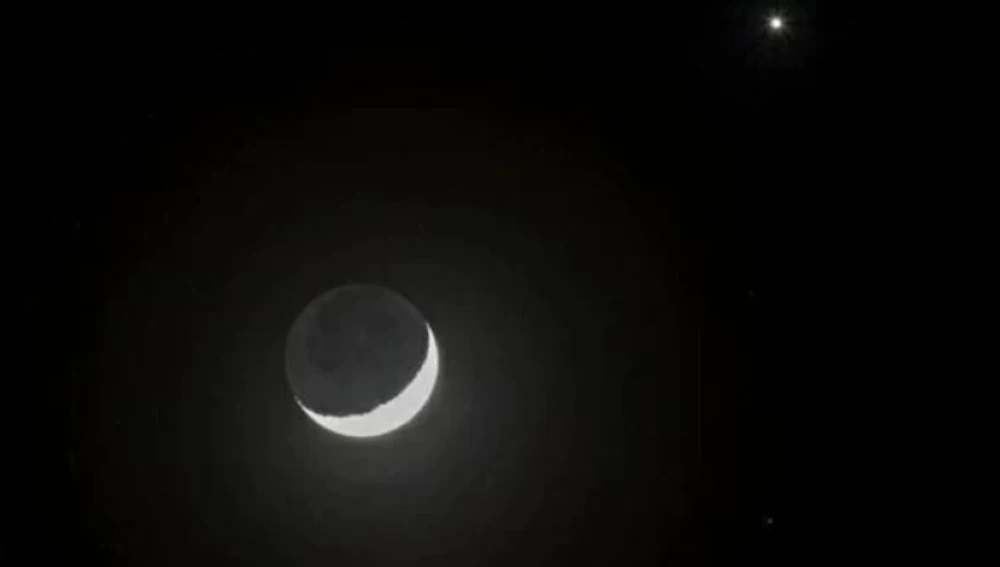
زيّن هلال شهر ربيع الأول المتزايد، مساء أمس، سماء السعودية مقترناً بكوكب الزهرة، في مشهد فلكي لافت أمكن رصده بالعين المجردة في الأفق الغربي بعد غروب الشمس، من المواقع التي تتمتع بأفق مكشوف وسماء صافية.
وظهر الهلال المتزايد بالقرب من كوكب الزهرة، أحد ألمع الأجرام في السماء، خلال فترة الشفق، فيما بلغت المسافة الزاوية الظاهرية بين الجرمين عند أقرب اقتراب نحو 1.8 درجة، قبل أن يبدأ بالابتعاد ظاهرياً مع استمرار حركة القمر في مداره حول الأرض.
وأوضح عضو نادي الفلك والفضاء محمد عناد الهزيمي، أن الاقتران يُعد من المشاهد الفلكية اللافتة التي تتكرر نتيجة الحركة الظاهرية للقمر والكواكب في السماء، مشيراً إلى أن تقارب الهلال مع كوكب الزهرة كان ظاهرياً بالنسبة للراصد من الأرض، في حين تفصل بينهما مسافات شاسعة في الفضاء.
وبيّن أن ظهور الهلال المتزايد إلى جوار الزهرة بعد غروب الشمس أتاح فرصة مناسبة لهواة الفلك والتصوير لتوثيق المشهد، لافتاً إلى أن مثل هذه الاقترانات تسهم في تعزيز الاهتمام برصد الأجرام السماوية والتعرف على حركتها ومواقعها في السماء.
ويُعد اقتران القمر والزهرة من الظواهر الفلكية الدورية التي يمكن مشاهدتها بالعين المجردة عند ملاءمة الظروف الجوية، ويكتسب المشهد جمالاً بصرياً لافتاً مع اجتماع الهلال المتزايد وسطوع كوكب الزهرة في الأفق.
The waxing crescent of the month of Rabi' al-Awwal adorned the sky of Saudi Arabia last night, accompanied by the planet Venus, in a striking astronomical scene that could be observed with the naked eye on the western horizon after sunset, from locations with an open horizon and clear skies.
The waxing crescent appeared near the planet Venus, one of the brightest celestial bodies in the sky, during twilight, with the apparent angular distance between the two bodies at its closest approach being about 1.8 degrees, before it began to appear to move away as the moon continued its orbit around the Earth.
Mohammed Anad Al-Hazimi, a member of the Astronomy and Space Club, explained that the conjunction is one of the striking astronomical phenomena that recur due to the apparent motion of the moon and planets in the sky, noting that the proximity of the crescent to the planet Venus was apparent to the observer on Earth, while vast distances separate them in space.
He indicated that the appearance of the waxing crescent next to Venus after sunset provided a suitable opportunity for astronomy enthusiasts and photographers to document the scene, pointing out that such conjunctions contribute to enhancing interest in observing celestial bodies and understanding their movements and positions in the sky.
The conjunction of the moon and Venus is considered one of the periodic astronomical phenomena that can be observed with the naked eye under suitable weather conditions, and the scene gains striking visual beauty with the gathering of the waxing crescent and the brightness of the planet Venus on the horizon.