


اكتشف علماء صينيون نظاماً ثنائياً لتسريع الجسيمات الكونية، باستخدام "مرصد الدش الهوائي الكبير" في مقاطعة سيتشوان جنوب غربي الصين.
ويقع المرصد على ارتفاع نحو 4410 أمتار فوق مستوى سطح البحر، ويمتد على مساحة 1.36 كيلومتر مربع، ويُستخدم لرصد الأشعة الكونية وأشعة غاما، وإجراء الأبحاث المتعلقة بها.
ووفقاً لباحثين من الأكاديمية الصينية للعلوم، يتكون النظام المكتشف من جسم مضغوط قد يكون ثقباً أسود أو نجماً نيوترونياً، ونجم مرافق ضخم، ويعمل هذا النظام على تسريع الجسيمات إلى طاقات عالية جداً عبر تفاعلات مرتبطة بالرياح النجمية القوية.
وقال الباحث الرئيس في المرصد وقائد الفريق البحثي تساو تشن: "إن التحليلات أظهرت قدرة النظام على تسريع جسيمات الأشعة الكونية إلى طاقات لا تقل عن 30 بيتا إلكترون فولت، مع تحديد منطقة تسارع الجسيمات بنطاق يقارب ثلاثة أضعاف نصف قطر الشمس".
ويفتح هذا الاكتشاف آفاقاً جديدة لدراسة الظواهر الفيزيائية المتطرفة بالقرب من الأجسام الكونية المدمجة، مثل الثقوب السوداء، والنجوم النيوترونية، وفهم آليات تسريع الجسيمات في الكون.
علماء صينيون يكتشفون نظاماً ثنائياً لتسريع الجسيمات الكونية
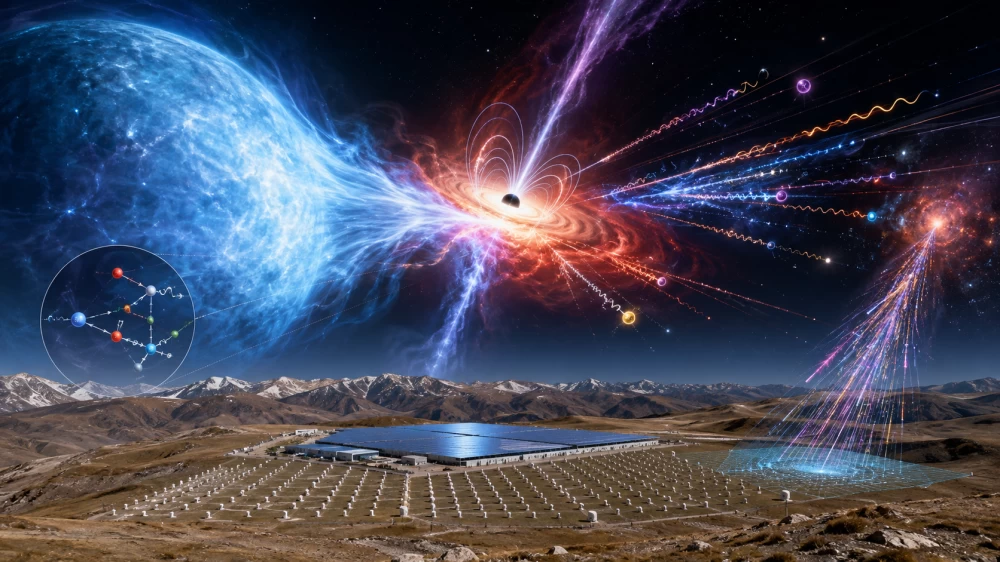


Chinese scientists have discovered a binary system for accelerating cosmic particles, using the "Large Air Shower Observatory" in Sichuan Province, southwestern China.
The observatory is located at an altitude of about 4,410 meters above sea level, covering an area of 1.36 square kilometers, and is used to observe cosmic rays and gamma rays, as well as conduct related research.
According to researchers from the Chinese Academy of Sciences, the discovered system consists of a compact object that may be a black hole or a neutron star, and a massive companion star. This system accelerates particles to very high energies through interactions associated with strong stellar winds.
The lead researcher at the observatory and head of the research team, Cao Chen, stated: "Analyses have shown the system's ability to accelerate cosmic ray particles to energies of at least 30 beta electron volts, with the particle acceleration region defined within a range of nearly three times the radius of the sun."
This discovery opens new horizons for studying extreme physical phenomena near compact cosmic objects, such as black holes and neutron stars, and understanding the mechanisms of particle acceleration in the universe.


