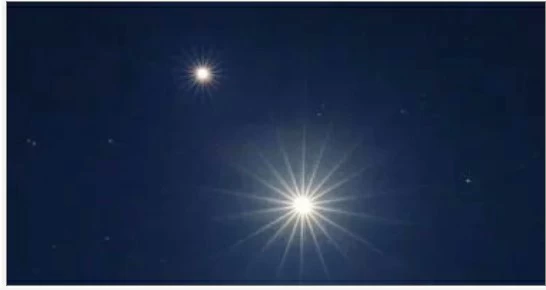
تشهد سماء المملكة، اليوم (الخميس)، اقترانًا لافتًا بين كوكب الزهرة ونجم قلب الأسد، في ظاهرة فلكية يمكن مشاهدتها بالعين المجردة، لمدة تصل إلى ساعتين بعد غروب الشمس.
وأوضح رئيس جمعية نور الفلك عيسى الغفيلي، أن الزهرة سيظهر كألمع جرم في الأفق الغربي، فيما يجاوره نجم قلب الأسد، وهو ألمع نجوم كوكبة الأسد. وبيّن، أن الاقتران هو تقارب ظاهري ناتج عن وقوعهما في الاتجاه نفسه بالنسبة للراصد على الأرض.
وأشار الغفيلي إلى أن نجم قلب الأسد يبعد نحو 79 سنة ضوئية عن الأرض، بينما يقع كوكب الزهرة داخل المجموعة الشمسية على مسافة تقارب 145 مليون كيلومتر، ورغم هذا التباعد الكبير يظهران متجاورين بسبب زاوية الرصد. وأضاف، أن أفضل وقت لمشاهدة الظاهرة يبدأ مباشرة بعد غروب الشمس، حيث يكون الجرمان منخفضين فوق الأفق الغربي، ويمكن رصدهما بسهولة بالعين المجردة.
وأكد، أن مثل هذه الاقترانات تُعد من الظواهر الفلكية الجميلة وسهلة الرصد، وتُسهم في تعريف الجمهور بمواقع النجوم والكواكب، وتعزيز الاهتمام برصد السماء ونشر الثقافة الفلكية.
Today (Thursday), the sky of the Kingdom witnesses a remarkable conjunction between the planet Venus and the star Regulus, in an astronomical phenomenon that can be seen with the naked eye for up to two hours after sunset.
The President of the Noor Astronomy Society, Issa Al-Ghafili, explained that Venus will appear as the brightest object in the western horizon, alongside the star Regulus, which is the brightest star in the constellation Leo. He indicated that the conjunction is an apparent closeness resulting from their alignment in the same direction relative to the observer on Earth.
Al-Ghafili pointed out that the star Regulus is about 79 light-years away from Earth, while the planet Venus is located within the solar system at a distance of approximately 145 million kilometers. Despite this significant distance, they appear adjacent due to the angle of observation. He added that the best time to observe the phenomenon begins immediately after sunset, when both objects are low above the western horizon and can be easily spotted with the naked eye.
He confirmed that such conjunctions are considered beautiful astronomical phenomena that are easy to observe, contributing to educating the public about the locations of stars and planets, and enhancing interest in sky observation and promoting astronomical culture.