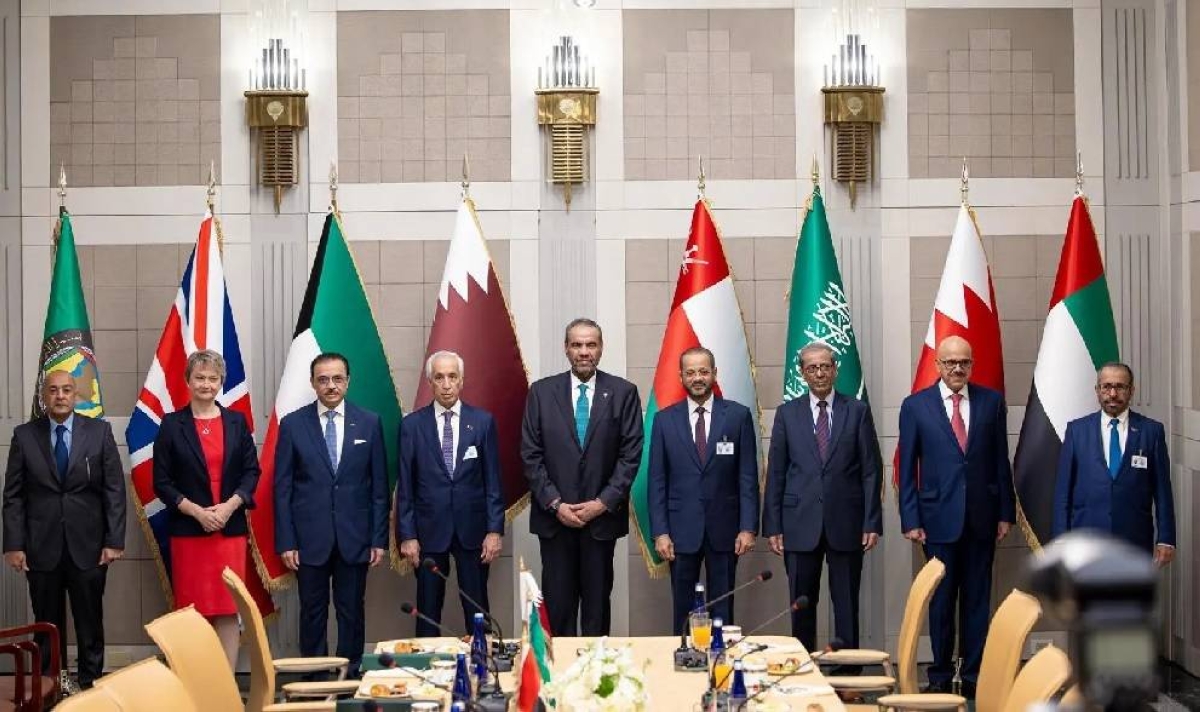
عقد وزراء خارجية دول مجلس التعاون لدول الخليج العربية، ووزيرة الدولة للشؤون الخارجية والكومنولث والتنمية في المملكة المتحدة إيفات كوبر، والأمين العام لمجلس التعاون لدول الخليج العربية جاسم بن محمد البديوي، اجتماعا في نيويورك اليوم، (الأربعاء) لمناقشة القضايا الإقليمية والعالمية، وتعزيز التنسيق بما يتماشى مع الشراكة الإستراتيجية بين مجلس التعاون والمملكة المتحدة، مع التركيز على تعزيز السلام والأمن والازدهار.
وأكد الوزراء في بيان مشترك، التزامهم بتعزيز السلام والعمل معا لحل النزاعات ومعالجة عدم الاستقرار، مشيدين بجهود دول مجلس التعاون لإنهاء النزاعات الإقليمية من خلال الوساطة والحوار وتعزيز التفاهم المتبادل.
ورحب المجتمعون بانتخاب البحرين عضوا غير دائم في مجلس الأمن الدولي للفترة 2026-2027.
وقرر مجلس التعاون والمملكة المتحدة مواصلة العمل معا بشكل وثيق لتحقيق السلام في المناطق غير المستقرة والمتضررة من الصراعات، معربين عن إدانتهم الهجوم الإسرائيلي على الدوحة في 9 سبتمبر، الذي شكّل انتهاكا صارخا لسيادة دولة قطر.
وأكد المجتمعون دعمهم سيادة لقطر وسلامة أراضيها، بما يتماشى مع مبادئ ميثاق الأمم المتحدة.
وحذر المجتمعون في بيان مشترك من أن هذه الإجراءات قد تُعيق مفاوضات وقف إطلاق النار في قطاع غزة، وهو السبيل الوحيد لتحقيق سلام دائم. وأعرب الوزراء عن دعمهم الكامل للدور الحيوي الذي تواصل قطر القيام به في جهود الوساطة بين إسرائيل و«حماس»، إلى جانب مصر والولايات المتحدة.
وأدان الوزراء الكارثة الإنسانية في قطاع غزة والقيود الإسرائيلية على المساعدات، التي أدت إلى تفاقم المجاعة والمعاناة الإنسانية. ودعا الوزراء جميع أطراف النزاع إلى الامتثال لالتزاماتهم بموجب القانون الدولي الإنساني، بما في ذلك حماية المدنيين والبنية التحتية.
وأشاد الوزراء بنجاح المؤتمر الدولي رفيع المستوى حول التسوية السلمية للقضية الفلسطينية وتطبيق حل الدولتين، الذي شاركت في رئاسته المملكة العربية السعودية وجمهورية فرنسا، الذي عُقد في الفترة من 28 إلى 30 يوليو، والاجتماع رفيع المستوى الذي عُقد في 22 سبتمبر بمقر الأمم المتحدة. وأكد الوزراء دعمهم جميع الجهود الرامية إلى إنهاء الحرب في قطاع غزة وتحقيق تسوية عادلة ومستدامة من خلال تطبيق حل الدولتين، وضمان الاستقرار والأمن لجميع دول المنطقة. كما أكدوا دعمهم لجهود التحالف الدولي لتطبيق حل الدولتين.
وأشاد الوزراء بالقرارات الإيجابية التي اتخذتها المملكة المتحدة ودول أخرى بالاعتراف بدولة فلسطين، مؤكدين الإجماع الدولي المتزايد على حل الدولتين.
وأكد الوزراء أهمية الحفاظ على الوضع التاريخي القائم للقدس ومقدساتها، معترفين بالدور الخاص للمملكة الأردنية الهاشمية في هذا الصدد، كما أكد الوزراء دعمهم للسلطة الفلسطينية.
وأكد الوزراء ضرورة وجود حكم موحد بقيادة فلسطينية في قطاع غزة والضفة الغربية تحت إشراف السلطة الفلسطينية. وجددوا التزامهم بدعم تطلعات الفلسطينيين في تقرير المصير، وضمان أن يكون الفلسطينيون محورا أساسيا في عملية الحكم والأمن والتعافي في قطاع غزة بعد انتهاء الصراع. وفي سياق إنهاء الحرب في غزة، يجب على «حماس» إنهاء حكمها في غزة.
ودعا الوزراء إلى خفض التصعيد في الشرق الأوسط، وأكدوا ضرورة التركيز على التوصل إلى وقف دائم لإطلاق النار، يُفضي إلى إنهاء الأعمال العدائية بشكل دائم، وإطلاق سراح جميع المختطفين، وتبادل الأسرى الفلسطينيين، والتوسع الكبير والمستمر في تقديم المساعدات المنقذة للحياة للمدنيين الفلسطينيين، وحثوا جميع الأطراف على التفاوض بحسن نية لاستعادة السلام والأمن في المنطقة، وشدد الوزراء على أهمية دعم وكالة الأمم المتحدة لإغاثة وتشغيل اللاجئين الفلسطينيين (الأونروا)، ودورها المحوري في دعم جهود الإغاثة والمساعدات الإنسانية والتنموية، وضمان استمرارها في أداء واجباتها بما يضمن توفير الاحتياجات الأساسية للشعب الفلسطيني.
وواصل الوزراء متابعة قضية الحدود البحرية بين جمهورية العراق ودولة الكويت، وأكدوا أن حل القضايا العالقة بين البلدين الجارين وفقا للقانون الدولي سيسهم إيجابا في استقرار المنطقة وتعاونها.
وأكد الوزراء أهمية سيادة دولة الكويت وسلامة أراضيها واحترام الاتفاقيات الدولية وقرارات الأمم المتحدة ذات الصلة، وخصوصا قرار مجلس الأمن رقم 833 بشأن ترسيم الحدود الكويتية العراقية.
وحث الوزراء على ترسيم الحدود البحرية بين الكويت والعراق بشكل كامل بعد العلامة 162، وفقا لاتفاقية الأمم المتحدة لقانون البحار لعام 1982، وقواعد ومبادئ القانون الدولي، وبما يتماشى مع الاتفاقيات السابقة.
ودعا الوزراء حكومة العراق إلى حل الوضع القانوني الداخلي لاتفاقية الكويت والعراق لعام 2012 لتنظيم الملاحة البحرية في خور عبدالله وضمان بقاء الاتفاقية سارية المفعول.
ورحّب الوزراء باعتماد مجلس الأمن الدولي قراره رقم 2792، مؤكدين مسؤولية المجلس في ضمان التنفيذ الكامل لجميع ولاياته وضمان العدالة والمساءلة، وأشاروا إلى دور الممثل الأعلى الذي ستُركز ولايته حصريا على تعزيز ودعم وتسهيل الجهود المتعلقة بإعادة أو عودة جميع الكويتيين ورعايا الدول الأخرى أو رفاتهم، وإعادة الممتلكات الكويتية، بما في ذلك الأرشيف الوطني. وحثّوا على بذل أقصى الجهود للتوصل إلى حل لجميع القضايا ذات الصلة.
وفي الشأن السوري، أكد الوزراء التزامهم بدعم الحكومة السورية في إحراز تقدم نحو انتقال سياسي شامل وتمثيلي وغير طائفي، يحترم حقوق جميع السوريين، بغض النظر عن خلفياتهم العرقية أو الدينية. ورحّب الوزراء بإعلان الجمهورية العربية السورية التوصل إلى خارطة طريق لحل الأزمة في محافظة السويداء، وأشادوا بالجهود التي تبذلها المملكة الأردنية الهاشمية والولايات المتحدة الأمريكية في هذا الصدد.
وشارك الوزراء التزامهم بدعم الحكومة السورية في تقديم مستقبل أكثر استقرارا وحرية وازدهارا. كما جددوا التأكيد على أهمية معالجة الاحتياجات الإنسانية المستمرة وتعزيز التعافي الاقتصادي، وشددوا على ضرورة تنفيذ الاتفاق بين الحكومة السورية وقوات سوريا الديمقراطية بشكل كامل. وأشاد الوزراء بجهود دول مجلس التعاون في تعزيز التعاون الاقتصادي، ودعم مسار سورية نحو التعافي والاستقرار.
وفي ما يتعلق بالأمن، شدد الوزراء على ضرورة أن توقف إسرائيل اعتداءاتها على الجمهورية العربية السورية، التي تزعزع أمن سورية ووحدة وسلامة أراضيها ومواطنيها، وتقوض جهود الحكومة السورية للحفاظ على الأمن والاستقرار. كما أكد الوزراء ما ورد في قرار مجلس الأمن رقم 2782 بشأن ضرورة التزام جميع الأطراف باتفاقية فض الاشتباك لعام 1974.
وجدد الوزراء التأكيد على أهمية التوصل إلى سلام عادل ومستدام في أوكرانيا، يقوم على احترام السيادة ووحدة الأراضي، وفقا لمبادئ ميثاق الأمم المتحدة. واتفقوا على تكثيف الجهود للتخفيف من التداعيات العالمية للحرب، بما في ذلك آثارها الإنسانية والاقتصادية والأمنية.
وأكد الوزراء التزامهم المشترك بتحديد مسارات عملية نحو تحقيق السلام. كما رحبوا بالجهود الجارية التي تقودها الولايات المتحدة بدعم من شركاء في الشرق الأوسط، مثل ما تقوم به المملكة العربية السعودية، لتسهيل الحوار وتعزيز الاستقرار.
كما أقر الوزراء أهمية التدابير الإنسانية، بما في ذلك تسهيل عمليات تبادل الأسرى، وجددوا دعمهم للمبادرات الرامية إلى التخفيف من المعاناة الإنسانية. وأشاد الوزراء بجهود دول مجلس التعاون للإسهام في حل سياسي للأزمة بين روسيا وأوكرانيا، ومبادراتها في الوساطة، والإفراج عن المحتجزين، وتبادل الأسرى، ولمّ شمل الأطفال مع عائلاتهم.
وأعرب الوزراء عن أسفهم العميق إزاء المعاناة الإنسانية المدمرة في السودان، واستذكروا الجهود المبذولة لإنهاء النزاع بين الأطراف المتحاربة. ورحبوا بالبيان الصادر عن وزراء خارجية دولة الإمارات العربية المتحدة، والمملكة العربية السعودية، وجمهورية مصر العربية، والولايات المتحدة الأمريكية في 12 سبتمبر 2025 بشأن استعادة السلام والأمن في السودان، وأشادوا بالجهود المبذولة في هذا الصدد، بما في ذلك مؤتمر لندن حول السودان في أبريل 2025، وعزم الوزراء على تنسيق الجهود لإنهاء النزاع، وضمان وصول المساعدات الإنسانية إلى المحتاجين، وحماية المدنيين. وفي الوقت الراهن، دعا مجلس التعاون والمملكة المتحدة إلى وقف فوري لإطلاق النار لأغراض إنسانية في مدينة الفاشر، لتمكين إيصال المساعدات على نطاق واسع إلى دارفور، ومعالجة الاحتياجات الإنسانية الملحّة للشعب السوداني الذي يواجه خطر المجاعة.
واتفق الوزراء على أن الحل الدبلوماسي ضروري لبرنامج إيران النووي، وأكدوا أن إيران لا يمكن أن تمتلك سلاحا نوويا، وأعربوا عن تقديرهم لجهود مجلس التعاون، وخصوصا سلطنة عُمان، للقيام بدور الوساطة بين الولايات المتحدة وإيران. وأكد الوزراء أن التصعيد الإقليمي لا يخدم مصلحة أي طرف، وجددوا التزامهم المشترك بدعم الاستقرار المشترك في المنطقة. كما أدانوا بأشد العبارات الضربات الإيرانية على قاعدة العديد في 23 يونيو.
وشدد الوزراء على أهمية التعاون البنّاء بين إيران والوكالة الدولية للطاقة الذرية، وعلى ضرورة تكثيف الجهود الدبلوماسية لضمان التزام جميع الأطراف بالاتفاقيات الدولية ذات الصلة، مما يسهم في بناء الثقة وتعزيز الأمن والاستقرار الإقليمي والدولي.
وجدد الوزراء دعمهم لدعوة دولة الإمارات العربية المتحدة للتوصل إلى حل سلمي للنزاع حول الجزر الثلاث، طنب الكبرى وطنب الصغرى وأبو موسى، من خلال المفاوضات الثنائية أو محكمة العدل الدولية، وفقا لقواعد القانون الدولي بما في ذلك ميثاق الأمم المتحدة.
وأكد مجلس التعاون والمملكة المتحدة سلامة وحرية الملاحة البحرية في البحر الأحمر، وأدان الوزراء اعتداءات الحوثيين التي أضرت بالبحارة الأبرياء، وهددت اقتصادات المنطقة والملاحة الدولية. وشددوا على ضرورة احتواء الأعمال المزعزعة للاستقرار من قبل الحوثيين، وأشاروا إلى الانتهاكات المستمرة لقرار مجلس الأمن 2216، بما في ذلك استمرار استيراد الأسلحة وتخزينها.
واتفق الوزراء على أن العملية السياسية التي تفضي إلى تسوية سياسية مستدامة هي الحل الأفضل على المدى الطويل لليمن. كما شدد الوزراء على أن وجود حكومة يمنية مستقرة وفعّالة أمر حيوي لتحقيق السلام والاستقرار. ودعوا المنطقة والمجتمع الدولي إلى تقديم الدعم اللازم للحكومة اليمنية.
وأدان الوزراء بشدة الاحتجاز غير القانوني لما لا يقل عن 19 موظفا أمميا منذ 31 أغسطس، مطالبين بالإفراج الفوري عنهم. وأعربوا عن قلقهم العميق إزاء ترهيب الحوثيين للعاملين في المجال الإنساني، لا سيما في ظل تفاقم انعدام الأمن الغذائي. ومع معاناة 18 مليون شخص من انعدام الأمن الغذائي الحاد وتوقع ظروف أشبه بالمجاعة، حثّوا على اتخاذ إجراءات دولية منسقة لمنع وقوع كارثة إنسانية.
وأشاد الوزراء بالجهود المتواصلة التي تبذلها المملكة العربية السعودية وسلطنة عُمان في التواصل مع جميع الأطراف اليمنية، وشددوا على أهمية إحياء العملية السياسية التي من شأنها أن تُفضي إلى حل سياسي شامل ومستدام في اليمن. وأكدوا أهمية انخراط الحوثيين في الجهود الدولية والأممية بصفته أمرا بالغ الأهمية لإنهاء الأزمة اليمنية، وتخفيف معاناة الشعب اليمني. كما أشاد الوزراء بإنجازات مركز الملك سلمان للإغاثة والأعمال الإنسانية، والدعم الإنساني الذي يقدمه مكتب تنسيق الشؤون الإنسانية والإغاثة لدول مجلس التعاون لدول الخليج العربية للجمهورية اليمنية، إضافة إلى المساعدات الإنسانية والتنموية التي تقدمها جميع دول المجلس لليمن.
وأكد مجلس التعاون والمملكة المتحدة على عمق العلاقات التجارية المتنامية، إذ تجاوز حجم التجارة الثنائية 53 مليار جنيه إسترليني (72 مليار دولار أمريكي) في 2024، واتفق الوزراء على أهمية تعزيز التجارة والاستثمار بين الجانبين لتعزيز النمو والازدهار المتبادلين.
كما أكد مجلس التعاون والمملكة المتحدة التزامهما بتعزيز التجارة الحرة، وأكد الجانبان التزامهما بإعطاء الأولوية لإبرام اتفاقية التجارة الحرة بين مجلس التعاون والمملكة المتحدة، مدركين أن إبرام اتفاقية تجارية مجدية من شأنه أن يعزز العلاقات التجارية والاستثمارية، ويفيد الشركات، ويدعم خلق فرص عمل للكفاءات العالية في المملكة المتحدة ودول مجلس التعاون.
وفي الختام، أكد الوزراء عزمهم المشترك على المساهمة في الأمن والاستقرار والازدهار الإقليمي في إطار الشراكة الإستراتيجية بين مجلس التعاون والمملكة المتحدة، وعزمهم المتبادل على بناء علاقات أوثق في جميع المجالات، بما في ذلك التعاون السياسي والأمني والاقتصادي.
The foreign ministers of the Gulf Cooperation Council (GCC) countries, the UK Minister of State for Foreign Affairs, Commonwealth and Development, Yvette Cooper, and the Secretary-General of the GCC, Jasem Mohamed Albudaiwi, held a meeting in New York today (Wednesday) to discuss regional and global issues and to enhance coordination in line with the strategic partnership between the GCC and the United Kingdom, focusing on promoting peace, security, and prosperity.
The ministers affirmed in a joint statement their commitment to promoting peace and working together to resolve conflicts and address instability, commending the efforts of the GCC countries to end regional disputes through mediation, dialogue, and fostering mutual understanding.
The attendees welcomed Bahrain's election as a non-permanent member of the United Nations Security Council for the term 2026-2027.
The GCC and the United Kingdom decided to continue working closely together to achieve peace in unstable areas affected by conflicts, expressing their condemnation of the Israeli attack on Doha on September 9, which constituted a blatant violation of the sovereignty of the State of Qatar.
The attendees reaffirmed their support for Qatar's sovereignty and territorial integrity, in accordance with the principles of the United Nations Charter.
The attendees warned in a joint statement that these actions could hinder ceasefire negotiations in the Gaza Strip, which is the only way to achieve lasting peace. The ministers expressed their full support for the vital role that Qatar continues to play in mediation efforts between Israel and Hamas, alongside Egypt and the United States.
The ministers condemned the humanitarian disaster in the Gaza Strip and the Israeli restrictions on aid, which have exacerbated famine and humanitarian suffering. They called on all parties to the conflict to comply with their obligations under international humanitarian law, including the protection of civilians and infrastructure.
The ministers praised the success of the high-level international conference on the peaceful settlement of the Palestinian issue and the implementation of the two-state solution, co-chaired by the Kingdom of Saudi Arabia and the French Republic, which took place from July 28 to 30, and the high-level meeting held on September 22 at the United Nations headquarters. The ministers reaffirmed their support for all efforts aimed at ending the war in the Gaza Strip and achieving a just and sustainable settlement through the implementation of the two-state solution, ensuring stability and security for all countries in the region. They also expressed their support for the efforts of the international coalition to implement the two-state solution.
The ministers commended the positive decisions taken by the United Kingdom and other countries to recognize the State of Palestine, affirming the growing international consensus on the two-state solution.
The ministers emphasized the importance of maintaining the historical status quo of Jerusalem and its holy sites, acknowledging the special role of the Hashemite Kingdom of Jordan in this regard, and reaffirmed their support for the Palestinian Authority.
The ministers stressed the necessity of having unified governance led by Palestinians in the Gaza Strip and the West Bank under the supervision of the Palestinian Authority. They renewed their commitment to supporting the aspirations of the Palestinians for self-determination, ensuring that Palestinians are a central focus in governance, security, and recovery processes in the Gaza Strip after the conflict ends. In the context of ending the war in Gaza, Hamas must end its rule in Gaza.
The ministers called for de-escalation in the Middle East and emphasized the need to focus on achieving a permanent ceasefire that leads to the permanent cessation of hostilities, the release of all hostages, the exchange of Palestinian prisoners, and the significant and ongoing expansion of life-saving assistance to Palestinian civilians. They urged all parties to negotiate in good faith to restore peace and security in the region, emphasizing the importance of supporting the United Nations Relief and Works Agency for Palestine Refugees in the Near East (UNRWA) and its pivotal role in supporting relief, humanitarian, and developmental efforts, ensuring it continues to fulfill its duties to provide the basic needs of the Palestinian people.
The ministers continued to follow up on the issue of maritime borders between the Republic of Iraq and the State of Kuwait, affirming that resolving outstanding issues between the two neighboring countries in accordance with international law will positively contribute to the stability and cooperation of the region.
The ministers emphasized the importance of the sovereignty of the State of Kuwait, its territorial integrity, and respect for relevant international agreements and United Nations resolutions, particularly Security Council Resolution 833 regarding the demarcation of the Kuwait-Iraq border.
The ministers urged the complete demarcation of maritime borders between Kuwait and Iraq beyond marker 162, in accordance with the United Nations Convention on the Law of the Sea of 1982, and the rules and principles of international law, in line with previous agreements.
The ministers called on the Government of Iraq to resolve the internal legal status of the Kuwait-Iraq Agreement of 2012 to regulate maritime navigation in Khor Abdullah and ensure the agreement remains in effect.
The ministers welcomed the adoption of Security Council Resolution 2792, affirming the Council's responsibility to ensure the full implementation of all its mandates and to guarantee justice and accountability. They noted the role of the High Representative, whose mandate will focus exclusively on promoting, supporting, and facilitating efforts related to the return of all Kuwaitis and nationals of other countries or their remains, and the return of Kuwaiti property, including the national archive. They urged maximum efforts to reach a solution to all related issues.
Regarding Syria, the ministers affirmed their commitment to supporting the Syrian government in making progress toward an inclusive, representative, and non-sectarian political transition that respects the rights of all Syrians, regardless of their ethnic or religious backgrounds. The ministers welcomed the announcement by the Syrian Arab Republic of reaching a roadmap to resolve the crisis in the Sweida Governorate, and commended the efforts made by the Hashemite Kingdom of Jordan and the United States in this regard.
The ministers shared their commitment to supporting the Syrian government in providing a more stable, free, and prosperous future. They also reiterated the importance of addressing ongoing humanitarian needs and enhancing economic recovery, stressing the necessity of fully implementing the agreement between the Syrian government and the Syrian Democratic Forces. The ministers praised the efforts of the GCC countries in enhancing economic cooperation and supporting Syria's path toward recovery and stability.
Regarding security, the ministers emphasized the need for Israel to cease its aggression against the Syrian Arab Republic, which undermines the security, unity, and territorial integrity of Syria and its citizens, and hampers the Syrian government's efforts to maintain security and stability. The ministers also reaffirmed what was stated in Security Council Resolution 2782 regarding the necessity for all parties to adhere to the 1974 Disengagement Agreement.
The ministers reiterated the importance of achieving a just and sustainable peace in Ukraine, based on respect for sovereignty and territorial integrity, in accordance with the principles of the United Nations Charter. They agreed to intensify efforts to mitigate the global repercussions of the war, including its humanitarian, economic, and security impacts.
The ministers affirmed their joint commitment to identifying pathways toward achieving peace. They welcomed the ongoing efforts led by the United States, supported by partners in the Middle East, such as those being undertaken by the Kingdom of Saudi Arabia, to facilitate dialogue and enhance stability.
The ministers acknowledged the importance of humanitarian measures, including facilitating prisoner exchanges, and renewed their support for initiatives aimed at alleviating humanitarian suffering. They commended the efforts of the GCC countries to contribute to a political solution to the crisis between Russia and Ukraine, their initiatives in mediation, the release of detainees, the exchange of prisoners, and the reunification of children with their families.
The ministers expressed their deep sorrow over the devastating humanitarian suffering in Sudan, recalling the efforts made to end the conflict between the warring parties. They welcomed the statement issued by the foreign ministers of the United Arab Emirates, the Kingdom of Saudi Arabia, the Arab Republic of Egypt, and the United States on September 12, 2025, regarding the restoration of peace and security in Sudan, and commended the efforts made in this regard, including the London Conference on Sudan in April 2025, and the ministers' determination to coordinate efforts to end the conflict, ensure humanitarian assistance reaches those in need, and protect civilians. Currently, the GCC and the United Kingdom called for an immediate ceasefire for humanitarian purposes in the city of El Fasher, to enable the wide delivery of aid to Darfur and address the urgent humanitarian needs of the Sudanese people facing the threat of famine.
The ministers agreed that a diplomatic solution is essential for Iran's nuclear program, affirming that Iran must not possess nuclear weapons, and expressed their appreciation for the efforts of the GCC, particularly the Sultanate of Oman, to mediate between the United States and Iran. The ministers emphasized that regional escalation does not serve the interests of any party and renewed their joint commitment to support mutual stability in the region. They also strongly condemned the Iranian strikes on Al Udeid Air Base on June 23.
The ministers stressed the importance of constructive cooperation between Iran and the International Atomic Energy Agency, and the necessity of intensifying diplomatic efforts to ensure that all parties adhere to relevant international agreements, contributing to building trust and enhancing regional and international security and stability.
The ministers renewed their support for the United Arab Emirates' call for a peaceful resolution to the dispute over the three islands, Greater Tunb, Lesser Tunb, and Abu Musa, through bilateral negotiations or the International Court of Justice, in accordance with the rules of international law, including the United Nations Charter.
The GCC and the United Kingdom affirmed the safety and freedom of maritime navigation in the Red Sea, and the ministers condemned the Houthi attacks that harmed innocent sailors and threatened the economies of the region and international navigation. They emphasized the need to contain destabilizing actions by the Houthis and noted the ongoing violations of Security Council Resolution 2216, including the continued import and storage of weapons.
The ministers agreed that the political process leading to a sustainable political settlement is the best long-term solution for Yemen. They also stressed that the existence of a stable and effective Yemeni government is vital for achieving peace and stability. They called on the region and the international community to provide the necessary support to the Yemeni government.
The ministers strongly condemned the unlawful detention of at least 19 UN personnel since August 31, demanding their immediate release. They expressed deep concern over the intimidation of humanitarian workers by the Houthis, especially in light of worsening food insecurity. With 18 million people suffering from acute food insecurity and expected conditions resembling famine, they urged coordinated international action to prevent a humanitarian disaster.
The ministers commended the ongoing efforts of the Kingdom of Saudi Arabia and the Sultanate of Oman in engaging with all Yemeni parties, emphasizing the importance of reviving the political process that would lead to a comprehensive and sustainable political solution in Yemen. They affirmed the importance of the Houthis' engagement in international and UN efforts as crucial to ending the Yemeni crisis and alleviating the suffering of the Yemeni people. The ministers also praised the achievements of the King Salman Humanitarian Aid and Relief Center, and the humanitarian support provided by the Office for the Coordination of Humanitarian Affairs and Relief of the GCC countries to the Republic of Yemen, in addition to the humanitarian and developmental assistance provided by all GCC countries to Yemen.
The GCC and the United Kingdom emphasized the depth of growing trade relations, with bilateral trade exceeding £53 billion ($72 billion) in 2024. The ministers agreed on the importance of enhancing trade and investment between the two sides to promote mutual growth and prosperity.
The GCC and the United Kingdom also affirmed their commitment to promoting free trade, with both sides committing to prioritizing the conclusion of a free trade agreement between the GCC and the United Kingdom, recognizing that reaching a viable trade agreement would enhance trade and investment relations, benefit businesses, and support job creation for high-skilled talents in the UK and GCC countries.
In conclusion, the ministers affirmed their joint determination to contribute to regional security, stability, and prosperity within the framework of the strategic partnership between the GCC and the United Kingdom, and their mutual resolve to build closer relations in all areas, including political, security, and economic cooperation.